
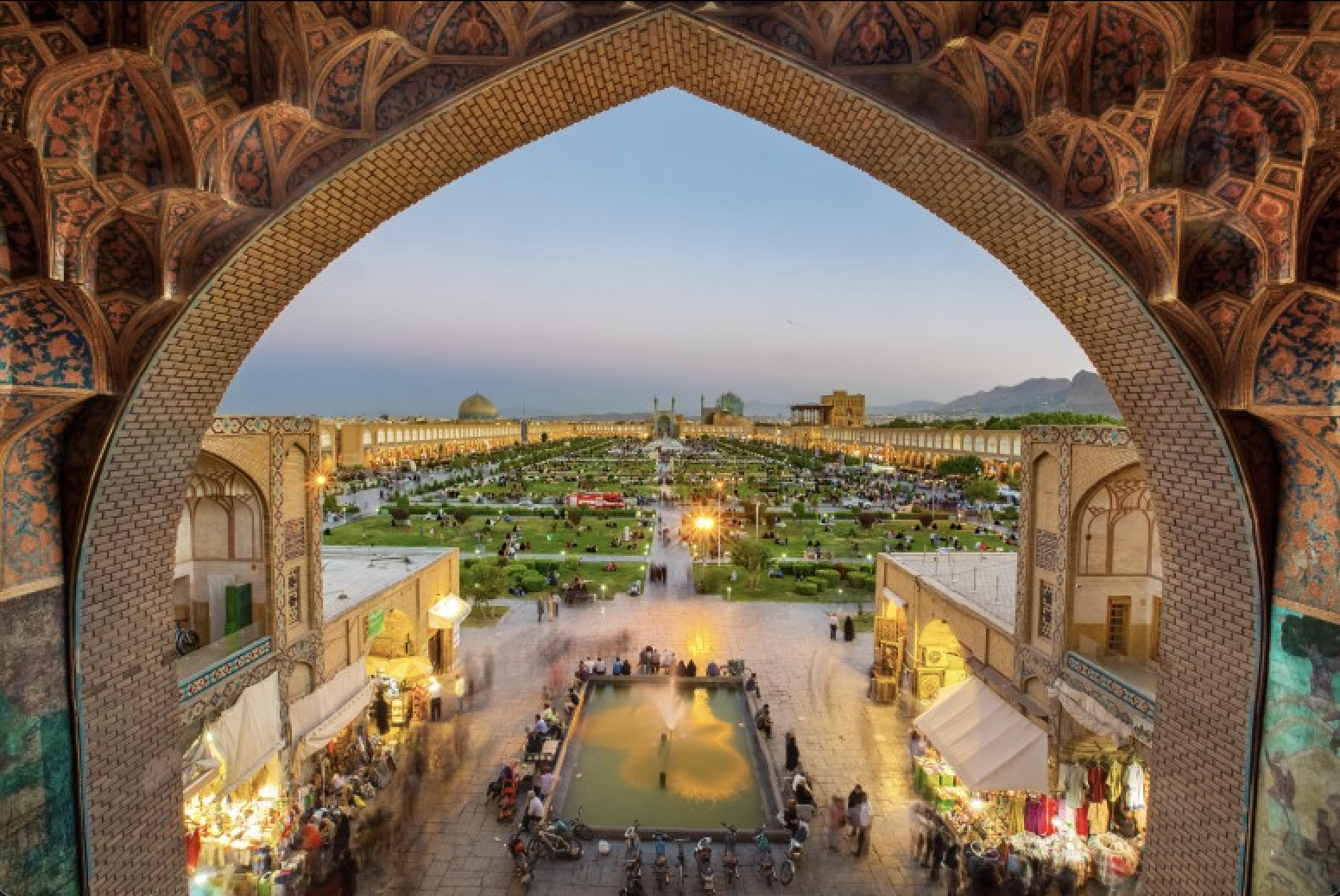
I have a tenuous connection with Iran, but it’s enough to sharpen the horror of what has unfolded there over the last few days. In the summer of 1969, my first year at university, I drove with three friends to Tehran at the invitation of a student friend whose father was an official in the Shah’s government.
This was one of two big trips I made in my late teens and early twenties, both of which marked me profoundly. The Iran journey had many highlights including two of the most surreal experiences of my life.
The first was watching the moon landing in a cheap hotel in downtown Tehran, with a commentary in Farsi. The second was spending an evening in the company of the Shah’s older sister, Princess Shams Pahlavi, and her family at her sumptuous desert residence, the Pearl Palace. I have previously written about both occasions, here and here.
My experiences of Iran were those of a self-absorbed nineteen-year-old on a road trip, who was at the same time trying to make sense of his parents’ very recent and wholly unexpected separation. I was only too ready to be captivated by the place, the people, the journey itself, and I was largely blind to what was really going on in the country at the time.
My view was also coloured by the romance of Iran’s ancient history, of which I knew a little from having studied classics at school. The word ‘Persia’ is, to my ear, a beautiful one: soft, elegant, pleasant in the mouth, strangely comforting (I have sometimes wondered, only half seriously, whether being born and growing up in similar-sounding Perthshire has anything to do with that).
In any event, ‘Persia’ for me summons images of songbirds, fountains and pleasure gardens, of poets and musicians, philosophers and storytellers, of graceful domes, minarets and gorgeous decorative mosaics. Back in 1969, these images soon became real as we crossed the border from Turkey and headed south. Isfahan, once one of the most important cities in central Asia, a major intersection for the silk and spice routes, took my breath away. It was the most beautiful city I had ever seen.
But the word ‘Persia’ is also redolent of conquest. At its height, the Persian empire stretched from Northern Greece to the Indus Valley and south to North Africa. I can still see figures such as Cyrus, founder of the ruling Achaemenid dynasty in around 550 BCE, and his son and grandson, Darius and Xerxes, in the pages of my school books. We visited Cyrus’s tomb at Pasagardae, and the ruined ceremonial capital at nearby Persepolis, where we could almost hear the trudging of thousands of feet as we gazed, in the settling desert dusk, at huge bas-reliefs of Darius’s and Xerxes’s armies.
I remember too the strange story, told by the historian Herodotus, of Xerxes ‘whipping the Hellespont’. Attempting to invade Greece – he was ultimately unsuccessful – he flew into a rage when a storm destroyed the pontoons he had built across the kilometre-wide Hellespont (the modern Dardanelles Strait). In his fury he ordered the water to be whipped 300 times and iron fetters thrown into the sea, to symbolise his power over nature. He also had his engineers executed.
A similar vicious arrogance was surely a factor in the Shah’s downfall, more than a couple of millennia later. Two years after my trip, in 1971, he hosted an unprecedentedly lavish, and largely bogus, celebration at Persepolis to mark 2,500 years of the Persian Empire and align himself as Cyrus the Great’s spiritual heir. (In 2016 the BBC’s Storyville series aired a documentary, as entertaining as it is horrifying, about the event: Decadence and Downfall: The Shah of Iran’s Ultimate Party.)
The cost of the celebrations, running into millions of dollars, did nothing to endear him to an already disaffected Iranian populace. Eight years later, Mohammad Reza Pahlavi, the man who had been welcomed by the West as a moderniser, who had ushered into Iran the era of mini-skirts and pop music, but who had also presided over Savak, the most chillingly efficient secret police in the world, was gone and the Mullahs were in power: a brutal autocracy replaced by an even more brutal theocracy.
The Iranians I met in 1969, like my student friend, were charming and hospitable, highly educated and sophisticated, liberal-minded heirs to their country’s millennia-long history of civilisation. I heard a commentator this week suggest that were it to become a liberal democracy, Iran would be an economic powerhouse ‘within a matter of years’.
I don’t doubt it; yet I remember from our journey through the country, from the Turkish border in the northwest to Shiraz, close to the Persian Gulf, in the south, that rural Iran was deeply conservative. It remains so today. This is where the Ayatollahs, these terrible, sclerotic old men, find their support, the ‘true believers’ who sustain them in what, we earnestly hope, are the dying days of their cynical and murderous regime.
I write this today, not because I claim any special knowledge of Iran, but in sorrow. My memories are more than half a century old, my experiences mostly those shared by any number of young western travellers who ventured east in that era. But it is these very memories that intensify the heartbreak I feel for that glorious country, its ancient culture; that make me want to write in elegy for its brave, beautiful people.









 A Few Kind Words