Soundscapes

What seems like a very long time ago now, I launched and published a monthly magazine for the radio industry. It was called, unsurprisingly, Radio Month and it aimed to do for the world of radio what Broadcast did for the television industry. I was the grandly-styled publisher and Nick Higham, who later went on to become BBC television’s media correspondent, was the editor. There were four of us altogether, in an unheated, rather smelly former shop on Dawes Road, in Fulham.

Radio Month was a trade magazine. It talked about programme-making and station management, studio equipment and the then relatively new business of selling advertising; commercial radio in the UK was only five years old when we launched and was still making itself up as it went along. We had a good run for three or four years, then came the recession of the early 1980s. Our own advertising dried up and the magazine went bust.
That painful moment was, quite directly, the start of my career as a business writer, although that’s another story. But working with the BBC’s Peter Day and his producer Sandra Kanthal through the recording of last week’s In Business programme about Dark Angels reminded me of two things in particular from that time.
The first is that radio then was populated mainly by enthusiasts. With a couple of notable exceptions (Kenny Everett, a true comic genius, being one) it wasn’t a celebrity medium. You could look like the back end of a bus and still be a brilliant broadcaster, the pay was generally lousy, the hours long, the working conditions sometimes hair-raising, and the company often eccentric. Most people who worked in radio did so because they really loved the medium. They were genuine, and genuinely committed. Sadly, I’ve lost touch with that world now so I don’t know whether the same is still true. I hope so. Peter and Sandra certainly both seemed cast in that mould.
The second thought, and it’s hardly an original one – though I think it connects with the first in some slightly opaque way, was that radio was, and remains, so much more a vehicle for the imagination than television. Peter and Sandra had nothing but a couple of microphones (one of them admittedly rather large and hairy, like an unkempt rat on a stick) and a tiny digital recorder with which to create half an hour of radio. The resulting programme was rich with the sound of bells, of footsteps, of different voices, of echo and its opposite – close presence, all building an atmosphere of Oxford and the mood of a Dark Angels course. It left one room to create one’s own pictures, all the more powerful for being personal. (Click here if you missed the programme.)
The analogy is there with good writing, which leaves room for one to attach one’s own thoughts and feelings to the words written; a lesson which the business world still largely has to learn. And perhaps the people who write well for business are also rather like the radio-makers, unseen craftsmen and women, who know how to create space for one to make an imaginative connection with the subject at hand, no matter how dry. These are not the people who would ever write, as I recently heard one organisation proudly declare, that they are ‘nurturing their talent pipeline’; for which Orwellian abstraction read people.
Tagged , , , , , , , | 1 Comment

Still crazy

Last weekend I went to see Wim Wenders’ film Pina, about the work of the pioneering German dancer and choreographer, Pina Bausch, and her company. It was an extraordinary two hours, not least because Pina herself died three weeks after filming began, but rather than abandoning the project, at the insistence of the company Wenders turned the film into a tribute to her. Inter-spersing the dance footage, each member of the company in turn speaks a few words to camera about what she meant to him or her. It must have been a profoundly emotional experience for them all.
Apart from these short spoken pieces the film was all dance and music. It was a feast of colour, movement and rhythm, some of it filmed during theatrical performances, some in ‘natural’ settings ranging from a river-bank to a steelworks, the rim of an open-cast mine to a busy motorway intersection. There were moments of humour and surprise, menace and tenderness, violence and joy. And underlying it all was a growing sense of the depth of Pina’s influence on her dancers – who came, it seemed, from almost every country under the sun.
I’m used to being transported by words, music and images, but less so by bodily movement and I was unprepared for how touched and inspired I felt by this film; not merely by the unseen but towering presence of Pina Bausch herself and the affection in which she was clearly held by her dancers, but by the beauty and grace of those lean, steel-muscled bodies, by their power to silently evoke all the emotional and psychological subtleties of what it is to be human.
Funnily enough, though, rather than making me want to dance, I left the cinema with a very strong craving for stillness. Those dancers, I felt, were able to move their bodies as they did, in some cases almost like acrobats, because they knew how to be still at their core, to create some point of inner calm and balance from which their control, and therefore the power of their movement and emotional expressiveness, flowed. That stillness was there in their faces even as they talked about Pina.
Life as I get older is not as I’d imagined it. It’s not slower and calmer, but faster and increasingly frantic. There is so much I want to do and never quite enough time to do it all. I’m sure I would do more still, and all of it better, if I could find that stillness. But it doesn’t come merely from the absence of activity; it’s the presence of something single-minded and disciplined, hard-won through years of practice. Yoga and meditation are paths to it. Perhaps we reach a version of it when we’re utterly absorbed in something, living only in the moment. But the trick must be in being able to put ourselves there at will, rather than waiting for the moment to strike.
I imagine it as a kind of gathering-in, of bringing all of oneself to a single point – which is just how Pina’s dancers were, the totality of their beings focused on each successive movement. Swap dancing for any other activity you care to name and the goal starts to become obvious, even if the means of reaching it are less so. But I love the paradox that these thoughts of stillness were triggered by a film about movement.
Tagged , , , , | 3 Comments

A Cup of Kindness

Tessa Ransford, distinguished Scottish poet and founder of the Scottish Poetry Library, sent me this in response to Friday’s post about Syria. She says: “I wrote this poem about three weeks ago after hearing Canon White from Iraq speaking on a Sunday morning interview on Radio Scotland.”


Faith, Hope and Charity

wrote St Paul in his hymn to Love
these three abide

In Iraq, explains Canon White on the radio,
Democracy is not what people yearn for
blasted on them as it was through missiles and bombs

What they most want, why can’t we understand,
is water, electricity and kindness
life, communication, things working normally

God only knows
Buddha only knows
Mohammed only knows
everyone knows we want the kindness
which lies at the heart of our being

For boys and girls, men and women, animals and plants
for all who go about their lives
for daily bread and caring for one another
it is kindness we want

In Scotland we have given a song to the world
‘a cup of kindness’
to take, to drink, to share

Water, electricity and kindness,
but the greatest of these is kindness.

Tessa Ransford
April 2011
Posted in Uncategorized | Tagged | Leave a comment

The road to Damascus?

Walking back from the polling station yesterday afternoon in the drizzle, past the familiar faces and houses of our village, I found myself trying to imagine what it would be like to live in Damascus where, aged 61, I would never have had the experience of voting in a free, democratic election; where I would have lived my adult life keeping my thoughts to myself for fear of informers or the secret police; and where now, today, I would most probably be living in real terror of arrest and torture, if I hadn’t already been carted off.

But the thought that really gnawed was this: where, knowing what faced me, would I find the courage to go out on the streets and protest? It seems to me that those thousands of ordinary people across the Arab world, and particularly those in Syria, who have recently joined the crowds knowing that they may simply not make it home that evening, that they may be picked off by snipers or mown down by tanks, or rounded up later and taken to some hideous secret interrogation centre ­– these ordinary people are quite extraordinarily brave.
Having never felt the resentment and anger they must feel, I don’t think I can really understand where that bravery comes from. It must be a huge rage, a consuming sense of injustice, that will make a peaceable person expose themselves to the possibility of extreme physical or psychological pain, or even death. And perhaps in voicing these thoughts I’m also acknowledging the fear that, if it came to it, I would turn out to be a coward, unable to find that courage.
I imagine that anger of this kind must have a quickening effect, a sharpening of the sense of being alive. Perhaps it even promotes a feeling of invulnerability, and certainly there must be a sense of solidarity, even of some kind of collective safety, while you’re in the crowd. But when the bullets begin to fly, or the door’s kicked in at three in the morning, doesn’t even the most righteous indignation yield to weak-kneed terror?
Last weekend, under a cloudless sky, I spent a morning at the magnificent new Culloden Moor visitor centre. The battle still casts a faint shadow over Scottish politics, more than two hundred and fifty years later, and I was reminded that for years afterwards the Hanoverians ran a kind of police state in the Highlands, in which actual and suspected Jacobites were ruthlessly hunted down and normal civil liberties – including the right to speak one’s language of birth – were brutally suppressed. I was so caught up in the drama of those far off events, and their wonderfully vivid interpretation, that I didn’t think of Syria at the time, nor, oddly enough, the fact that we were less than a week away from our own election.
But I see the connections and parallels clearly now, and it reminds me just how fortunate we are to live in a democracy; also how vital it is that we lead politically engaged lives, that we stay informed, that we vote and that we teach our children to vote. That way, with luck, our courage may never be put to the test.
Tagged , , , , | 3 Comments

Curiouser and curiouser

A couple of times most weeks I take the train to Edinburgh. For several miles the line follows the Fife coast. There’s a long view south under huge skies across the Forth Estuary to Edinburgh and its acropolis, the Pentland Hills looming behind. In places the track runs very close to the shoreline and at low water there are colonies of seaweedy boulders, great expanses of mudflat, and flocks of wading birds to be seen. Yesterday morning was one of brilliant sunshine and air of a particularly limpid clarity, the water ruffled by a light breeze. At one point, as we rounded a headland, there, crossing a small bay was a solitary kayak, its paddler oblivious to the fact that twenty yards behind him, head and neck raised clear of the water, followed an inquisitive seal.

When we are curious we feel alive. Witnessing such a thing on a journey to work made me feel that a good day lay ahead, and indeed it did. First there was a meeting with Paul Pinson, theatre director turned executive coach, who partnered me on the Indian adventure last year. Paul gave me invaluable feedback on a story-telling workshop I’m preparing. Keep spelling out the business benefits and giving real life examples, he urged me. You may have all this knowledge, but to your audience it’s a new concept and they need to be reassured that what you’re telling them actually works. There’s no end to what we can learn, nor the satisfaction in it, I thought as I left.
Next came an Edinburgh International Book Festival board meeting: two hours of solid concentration, one tricky decision, and the thrill of hearing details of this year’s programme – a banquet of contemporary fiction and current thinking on everything from science and the environment to the Arab Spring and the growing power of China. Book festivals are a modern cultural phenomenon and more appear practically every week. With 750 events and more than 200,000 visitors over 17 days, we claim ours to be the world’s largest. But where does this desire to hear authors talking come from? I believe it’s about curiosity and learning again. Book festivals are really festivals of thinking and we hunger for the imaginative connections we can make, the sense of belonging we can experience, by hearing new, interesting and challenging ideas in the company of others.
From Edinburgh I travelled to St Andrews, back along the Fife coast under a still unblemished sky, with another colleague. Robert Fletcher, former chairman of Saatchi’s New York, is a genius at helping brands of all kinds to communicate why the world would be a poorer place without them. In this instance the brand is St Andrews University, which in two years’ time will be 600 years old and needs to find a compelling way to raise many millions of pounds over the coming years in the seemingly paradoxical pursuit of remaining small. Even ancient seats of learning have lessons to learn, in this case that the institutional voice will not always serve it best. 
     Nowhere is human curiosity more visibly enshrined than in a place such as St Andrews. It’s not just what makes us feel alive. It’s what keeps us moving forward.
Tagged , , , , | 1 Comment

Standing under

I suppose Easter weekend is as appropriate a moment as any to write about empathy. In the Christian calendar, at least, it represents the high point of suffering; and empathy translates literally from the Greek as ‘suffering in’ (as opposed to sympathy, ‘suffering with’).

But that’s not what has prompted me. The trigger, in fact, is a TED talk I was directed to this week, in which American sociologist Sam Richards illustrates empathy by taking his audience step-by-step through the process of identifying with an Iraqi insurgent. He does it by first unfolding an imaginary scenario in which a hugely powerful China, dependent on American coal, sends an army of occupation into a conflict-ridden United States; then drawing the parallel with the situation in Iraq and inviting the audience to imagine how an ordinary Iraqi might feel about the Americans – which is not, as he crucially points out, the same as agreeing with that person. In a post-9/11 US, it’s a brave but effective way of making his point.
Richards describes sociology as ‘the study of the way humans are shaped by things they can’t see’; and empathy, he tells his students, is everything because to study those invisible forces you must be able to understand other people. The OED defines empathy as ‘the power of projecting one’s personality into, and so fully understanding, the object of contemplation’. The literal meaning of the word ‘understand’ is to ‘stand under’, and at one point in his talk Richards takes a pace to one side, then turns through 180 degrees to face the way he has been facing previously, thus miming the act of stepping into someone else’s shoes, or ‘standing under’ them. I was amused because I make the same movement when talking to people about the importance of empathy in writing. It must be the default gesture for empathy, and I love the implication that we intuitively under-stand that selfsame word’s intrinsic meaning.
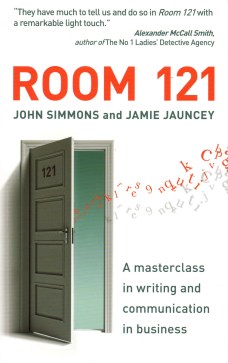
Empathy was constantly on my mind when John Simmons and I were writing Room 121, earlier on in the year. Not only is it one of the defining themes of the book, but in the writing John and I were almost daily inviting empathy, one with the other, as we swapped stories. Even so, the impulse to tell an audience what you want to say rather than what they want to hear can be a powerful one. I’ve been caught out in the past when talking to people whose grasp of stories and language has been more literal than I had appreciated, and seen the blank looks resulting from my assumption that they will ‘get’ the emotional torque of a phrase or story without my having to explain it.
Empathy, it seems to me, is the principal means of bridging the gap between our human differences. It’s not possible without the capacity to imagine. But it also requires an effort of will, a wish to connect, even if not necessarily to concur – and when that is absent, all manner of troubles ensue. Imagine what might have happened had Sam Richards given his talk to an audience of Romans, inviting them to empathise with a rabble-rousing Judaean mystic.
Tagged , , , , | 2 Comments

Chinook secrets

In June 1994 an RAF Chinook helicopter, travelling from Northern Ireland, flew into a hillside on the Mull of Kintyre, killing everyone on board. Alongside the four crew, the 25 passengers included almost all the UK’s most senior Northern Ireland intelligence experts. It was a security catastrophe, and because the crash happened in dense fog there were no witnesses.

The following year an RAF board of enquiry, led by two air-marshals, concluded that it was the result of pilot error. They found the two young flight lieutenants, Jonathan Tapper and Rick Cook, aged 28 and 30, guilty of gross negligence in flying too fast and too low for the prevailing conditions.
But the pilots’ families and many others, including a number of prominent figures, disagreed. In the years that followed there were several inquiries and reports, all of which challenged the original conclusion or left the question of blame open.
In 2001, my father chaired the last of these inquiries. It was one of the final jobs he undertook as a retired Law Lord. He found that the air marshalls had effectively inferred negligence from the absence of any evidence to the contrary, a decision that would have been impermissible in any civil court; and that they were therefore wrong to have reached the conclusion they did.
As Malcolm Rifkind, Defence Secretary at the time of the original inquiry, wrote in the Sunday Herald, shortly after my father’s report was published: “The immediate reaction of the government was made by armed forces minister Adam Ingram within hours of the publication of the report. He could hardly have had time to read it, but he appeared to dismiss it as containing nothing new. The implication was that the government would not budge.”
My father was quietly furious, not because this was yet another report the government was going to kick into the long grass, but because he felt the case against the young pilots was far from proven and feared that a genuine injustice was being perpetrated against them. Sad then that he didn’t live to hear the news, just this week, that the BBC have uncovered an RAF internal report, written two years before the accident, which seriously questioned the airworthiness of the Chinook on a number of counts. The report had never been seen by any of the previous inquiries; the clear implication being that it had been buried by the MoD.
Another review is currently under way and now, at last, it seems that the pilots’ names may be cleared and the families might see the justice their sons deserve. All of which leaves one gasping at the cynicism of an organisation that would rather blame two young men than admit to its own failings. Though perhaps that’s a naïve view. Even in these more transparent times, the MoD carries with it a hefty legacy of secrecy.
On the other hand, maybe the MoD is not so different from the many other organisations where that kind of cynicism and secrecy and lack of proper regard for individuals is a fact of daily life. On the Dark Angels course at Merton we talked a lot about the parlous state of dysfunction that so many organisations seem to have reached these days. Mark Watkins, who lives and works in Denmark, put it particularly well with this description of a kind of reverse alchemy: “Imagine you’re on your way to your first day in a new job. You’re full of enthusiasm, purpose, the wish to contribute, to make a difference, to be useful. How hard does your organisation then have to work to turn that gold into lead, that energy into apathy?” The answer is either quite hard, or not very hard at all. Both are sadly true.
Posted in Uncategorized | Tagged | 4 Comments

Summing up

I heard yesterday that my novel The Witness has finally earned out its advance, nearly four years after publication. Jenny Brown, my agent, tells me that a cheque for about £20 is on its way to my account. Champagne all round, then.

  The economics of writing novels have never really made much sense for me. I started this book, my fourth, in around 2001, as an adult novel, and finished the first draft about three years later. It did the rounds of a dozen major fiction publishers and was turned down by all of them, though one or two said they thought it might work as a young adult title. So we took it to Macmillan Children’s Books who agreed to give it serious consideration if I was prepared to re-write it. I eventually did, once I’d realised that almost the only thing I needed do was re-cast the main character, making him an 18- rather than 45-year-old; everything else stayed much the same. It took me six months and I was rewarded by a contract with Young Picador and a £5000 advance.
  The Witness was eventually published in August 2007, about a month after my father died. I think he always found it difficult to engage with this part of my life; he hardly read any fiction and the literary world was one he seemed to find hard to relate to. Yet the very last words he said to me, a couple of days before he died, were: “good luck with the book, old boy.” I would have liked him to see it in print; better still read it since there was much in it – the Highland landscape and way of life, issues of land-ownership, traditional music – that he would have enjoyed. But he’d suffered a severe stroke two years previously and wouldn’t have been able to read it, even if he had lived.
Today, it’s nearly ten years since I started work on the book. That means its earnings average £500 per annum. Its successor, The Reckoning, fares better because I wrote it much more quickly. I started work on it in January 2008 and it was published in November 2009. I also received a bigger advance, £6000. So The Reckoning has averaged slightly under £2000 a year so far, though that figure will decrease because the book isn’t yet close to earning out its advance. In total, including lending royalties but excluding appearance fees, writing fiction has brought me around £30,000 since my first novel was published in 1990. Call that £1500 per annum. Hah!
Yesterday – by coincidence, or perhaps not – just before I heard the extravagant news from Jenny, I had started work again on the last in this series of three young adult novels. I have been stalled at page 200 for over a year, mainly, though not wholly, through pressure of work. The other reason for the hiatus is that despite The Witness and The Reckoning being shortlisted for successive Royal Mail Scottish Children’s Book of the Year Awards, despite my going into something close to fifty secondary schools over a two-year period and promoting the books as hard as I possibly could, Macmillan deemed me not to be selling enough and sacked me in summer 2009. So there’s no contract and no advance for The Artefact, as it’s provisionally titled.
Why on earth am I bothering, then? It will be another six months’ hard graft, squeezed in between everything else, with the very real possibility of the book never seeing the light of day. Should a publisher materialise the advance will be nugatory, such is the current state of publishing, and I will almost certainly have to commit to a follow-up. Why bother? I’ve been asking myself this question for some months. I continued to ask it when we were at Merton last week, where I finally came to the simple conclusion that the story demands to be finished. It’s a living, growing thing, and to let it wither on the vine would be tantamount to abortion. I feel morally obliged to it, such is the power and energy of story.
Posted in Fiction, Publishing, The Reckoning, The Witness | Tagged , , | 6 Comments

Oxford blue

I’m in Oxford now, at Merton College. Our Dark Angels students are working on their projects and I’m finding a brief moment of quiet in my room, remembering the first time I ever came here.
  I was twelve years old. My mother had driven me down from Scotland to sit the scholarship exam for nearby Radley College; an heroic twelve-hour journey in a Morris Minor Traveller. We stayed, in what felt like tremendous splendour, at The Mitre, an ancient half-timbered pub on the High Street. We went to look at Christ Church, where my father had been a student, and wandered around the vast-seeming Tom Quad. I wanted to visit Carfax and Turl, streets my father had mentioned, simply because they had such strange names; I don’t remember if we did. I do remember feeling highly embarrassed, but also secretly rather proud, of being made to wear a kilt for the interviews. There were very few Scots at Radley in those days, and I think it caused a stir.
  I didn’t get the scholarship, but a kind of consolation prize in the form of an exhibition (to this day I don’t know why they’re so called), which meant I had my name in italics, rather than bold, in the school list. It was worth £80 a year. It also meant that Oxford featured prominently in my life for the next five years. With leave from our housemasters, we cycled the five miles at weekends and loitered, ogled girls, spent our pocket money on records and improbable clothes (it was the mid-60s), occasionally went punting and inevitably, as we got older, pubbing – which involved dodging the dons, as Radley also styled its teaching staff. My home was deep in the Scottish countryside, and Oxford became much of what I knew about the grown-up world throughout my teenage years.
  But I didn’t fulfil the promise of the exhibition. I was pushed early into the classics department to study Latin, Greek and Ancient History, a tiny hothouse for which I was neither temperamentally nor intellectually suited. Well into adult life I continued to have nightmares about sitting the Greek unseen exam without having memorised enough vocabulary. By the time I sat Oxford entrance, my academic career had followed a steady downwards trajectory for three years and I was thoroughly demoralised. Christ Church turned me down for PPE and I ended up in Aberdeen reading Law.
  I brushed it off at the time, one does at the age of eighteen, and went on to enjoy greatly my time at another ancient university, the other end of the country. I gave the whole thing very little thought until much, much later, only a few years before my father’s death. He had been at a dinner for eminent Christ Church alumni where someone had said to him: ‘not surprising your son didn’t get in in 1967, the college had become very left-wing and the fact that you had been there would have gone against him.’
  I was touched that he passed this on; it felt like a kind of apology. But it also reminded me that somewhere inside, the rejection had always slightly rankled. Not because I felt that I should have got in, but because I knew perfectly well that I hadn’t been up to it, the entrance exam the culmination of a three-year failure of education. After taking two A-levels, aged fifteen, and scoring two e-grades, I’d begged to be allowed to change from classics to modern languages. My housemaster’s response was to note in my report that I needed to grow up. I was trying.
  And yet, these things are seldom black and white. Those three years of intensive Latin and Greek vastly increased my grasp of the English language and made me the writer I am. Without them I might easily not be at Merton now. On the other hand, my two Dark Angels colleagues, John and Stuart, both studied at Oxford. Sitting here now in a medieval building, at a desk in an undergraduate room, off a spiral stone staircase so narrow I almost have to turn my shoulders to climb it, I won’t pretend I don’t envy them.
Tagged , , , , , | 5 Comments

More dreams and portents

Next week we go to Merton College, Oxford to run the second of our biennial Dark Angels masterclasses. It will be an exciting few days. Not only do we have BBC Radio 4’s In Business team joining us for part of the time to make a programme about the course, but also the best-selling author Philip Pullman is coming as our guest speaker. There’s a special resonance here because Philip’s trilogy, His Dark Materials, and John Simmons’s book, Dark Angels, from which our courses take their name, both owe inspiration to Milton’s Paradise Lost; while Philip’s literally fabulous landscape is a kind of ever-present backdrop to our own work. As if that weren’t enough, we’re housed in one of the most ancient Oxford colleges, one of whose boasts is the oldest continuously functioning academic library in the world, built in 1373. I remember from last time we were there the sense that wherever one turns at Merton, knowledge seeps from the masonry.
  Our ten students are all from business, and they represent activities as diverse as television and Formula One motor racing, environmental and communications consultancy, and freelance writing. They have all previously been on our advanced course in Spain, so they know the score. As always it will be a cocktail of the personal and the professional, with exercises related both to the world of work and to their individual creativity, as we continue to make the point that good writing is good writing, no matter what the context; and in business, good writing means better communication, better connections, better decision-making, better relationships, better pretty well anything you care to name.
  As preparation, we ask everyone to re-write a piece of typically bland financial services writing in the style of a novel we have allocated them, a novel that has a connection – either through its author or subject – with Oxford, for example: Brideshead Revisited, The Hobbit, Zuleika Dobson, The Hunting of the Snark (not a novel, I know), Jude the Obscure, The Lion, The Witch and the Wardrobe and others. As well as offering plenty of scope for amusement, the exercise makes serious points about tone of voice and the value of a more imaginative approach to writing about business subjects. There will also be poems and stories, a field trip into the city itself, and one-to-one tutorials.
  I’m hugely looking forward to it. It will be an intense three days and we tutors will get as much out of it as the students. Though this, which came in yesterday from a friend in response to my two recent posts about Tycho Brahe, elevates the whole concept to new and undreamt of heights:
  “A propos your dream the other week, I had a dream last night you might find interesting. Dark Angels had taken out a whole page advert in a broadsheet – I think it was the whole front of the Guardian, but no masthead on it, with your website address www etc… in very large letters going right across the page (and underlined) with wings either side, but half a wing, a sort of capital D on its side… I can’t remember what it said exactly but the gist was that with everything going on in the world it was time for people to listen to what the Dark Angels had to say to change the world for the better. I can remember thinking, in the dream, that I would need to get in touch with you to help because you would be inundated with people contacting you. There was also some sort of image, I think it might have been Mount Rushmore, but instead of the presidents, it was the faces of you, Stuart and John in the rock.”
  So, no pressure next week, then … And Susan, stand by your phone.
Tagged , , , , , | 1 Comment