
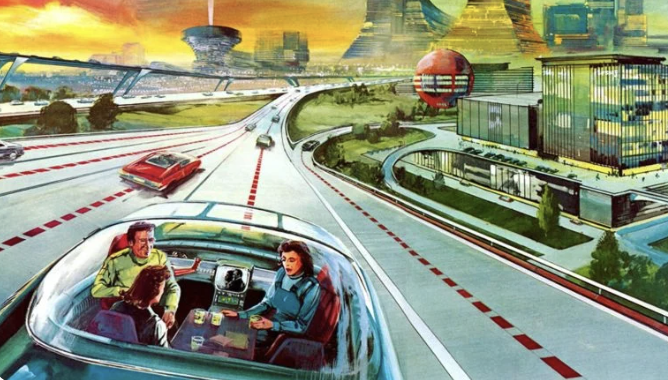
When I posted about the myth of Pandora, ten days ago, I was writing with specific reference to AI and the fact that, if the media are to be believed, it is already out of control.
I didn’t spell this out because I assumed, quite wrongly as it turns out, that that was where everyone would naturally be taken by my retelling of the myth. In my mind the creatures issuing from Pandora’s jar in the illustration by Christina Balit were clearly rogue AI agents.
But not so clearly to others, it seems. It was a useful, and humbling, reminder that what is uppermost in my mind is not necessarily so in other people’s; and that the best myths work precisely because they’re open to a multitude of interpretations.
However, it has left me thinking about how it’s so often the storytellers who have it when it comes to imagining the future and anticipating events. While I’ve always loved the classical myths, I also used to read a lot of science fiction, and now three instances of a kind of foretelling come immediately to mind.
Arthur C Clarke, who I was lucky enough to visit in Sri Lanka in 1985, was not the only one to imagine artifical intelligence taking matters into its own hands; though the idea has seldom been more dramatically presented than in Stanley Kubrick’s movie of his novel, 2001: A Space Odyssey.
In the story, HAL 9000 is the sentient general-intelligence computer that controls the spaceship and communicates with the crew on their mission to Jupiter to investigate an alien monolith.
When HAL starts to show signs of malfunction, the crew discuss disconnecting its cognitive circuits. They have made sure that their conversation cannot be heard, but they are not aware that HAL can also lip-read.
Faced with disconnection, HAL attempts to kill the astronauts in order to protect itself, and the mission.
In various other stories Clarke predicted, by many years, satellite television, a version of the world wide web, online shopping, banking and other computer-based conveniences.
Also, in 1945 he famously published a paper in Wireless World proposing that at a certain distance (22,236 miles), a satellite would orbit synchronously with earth’s rotation and so would appear to be stationary above a fixed point on earth’s surface.
Nearly twenty years later, NASA launched the first geostationary satellite. Today these form the essential infrastructure of global communications systems, their orbit known as the Clarke Belt.
Clarke’s contemporary and friend Isaac Azimov was also thinking about artificial intelligence at the time Clarke was gazing heavenwards. In his short story, Runaround, which was published in the 1950 collection, I Robot, Azimov proposed the now-famous three laws of robotics:
- A robot may not injure a human being or, through inaction, allow a human being to come to harm.
- A robot must obey the orders given it by human beings except where such orders would conflict with the First Law.
- A robot must protect its own existence as long as such protection does not conflict with the First or Second Law.
He wrote Runaround in 1942 and presented the three laws as being from the fictional Handbook of Robotics, 56th edition, 2058 AD – one hundred and sixteen years in the future at the time of writing, which must then have seemed impossibly distant.
Isaac Azimov died in 1992, Arthur C Clarke in 2008. Both writers’ stories continue to be widely read because they were informed by serious scientific understanding, coupled with fertile imaginations that ranged far into the future.
In contrast the originators of the Pandora myth, millennia earlier, had only metaphor to hand. But they all shared at least one fear for mankind: that one day we would create something many times more powerful than we are, which we might not be able to control.
What would they all be thinking now?






If they were still here they wouyld undoubtably have updated their warnings. As well as broad scientific knowledge they were “old school” broad reach people not just buried in their own disciplines but connected to the wider world. Too many of the leaders in AI are nerds who seem to think everything is just a big computer game. The recent problems with Air Traffic Control were the result of small bits of code in programming screwing the whole system. This cost millions and had an effect on thousands of people. It doesn’t take much of an imagination to consider howcatastrophic the actions of a human “Bad Actor” or a rogue AI system could be. We are all in the “wired” world and at at real risk. We are all also at the mercy of the busted flush that is the American Constitution and Supreme Court. The last thing we need at the moment is the grotesque orange lump as US President. All this coming together at does not bode well for the world.
LikeLiked by 2 people
Very good point about them being generalists, Steve. There don’t seem to be many of those around today!
LikeLike
I must admit, I thought the original blog was simply the most detailed analysis of the Pandora’s Box fable I’d ever heard. And the contents of the box quite different from anything I remember being told as a child. Didn’t occur to me you were writing a fable for our time! Sent from my iPadOn 28 Sep 2026,
LikeLiked by 1 person