
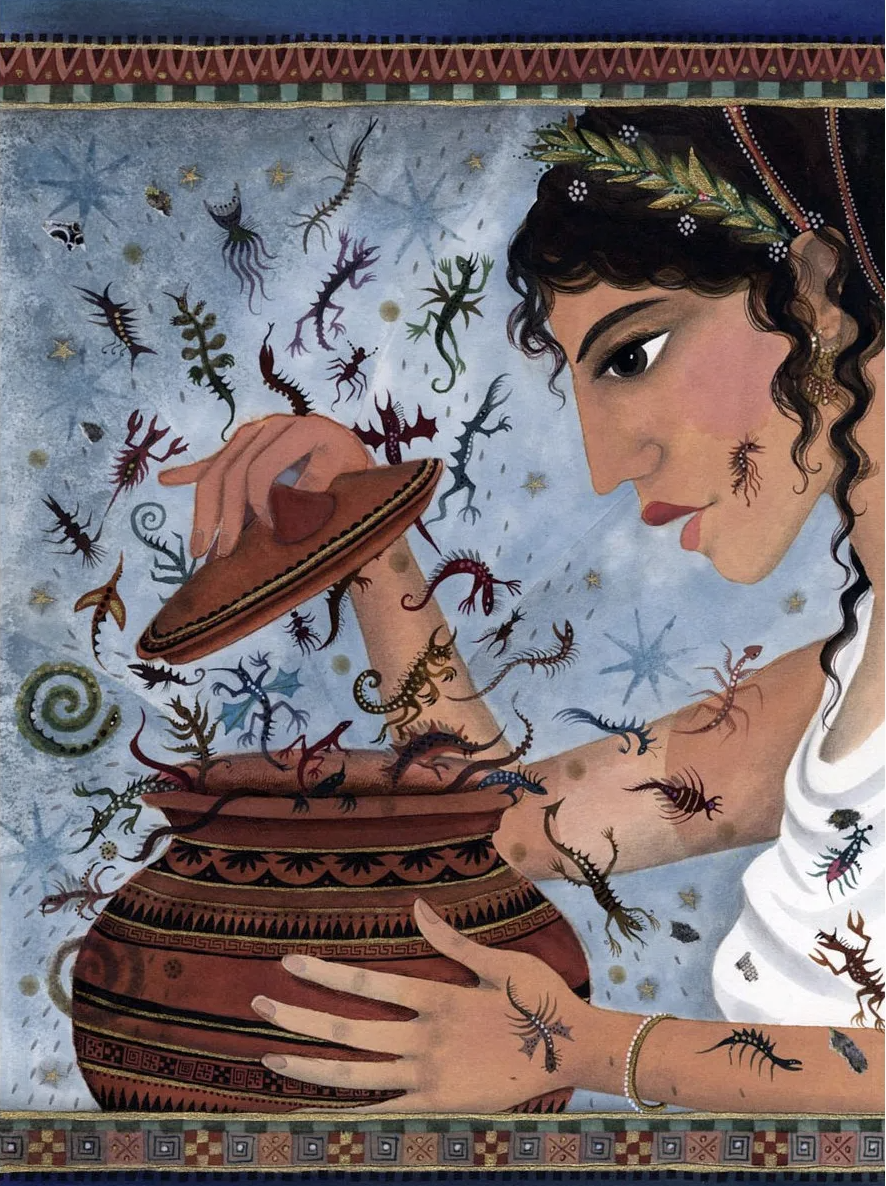
In the last few days, for perhaps obvious reasons, I’ve found myself thinking a lot about Pandora and her box, but I realised that I don’t know her full story, so here it is.
It all begins with Prometheus, who was one of the Titans, the original masters of the universe until they were brought down in a long and terrible war waged by their cousin, Zeus. Zeus then took their place with his fellow Olympian gods.
Prometheus, whose name means ‘forethought’, retreated to the countryside. He loved the earth and everything it bore, but it felt empty and he was lonely.
Taking clay from the river, and seeds of life from Chaos, the stuff of which everything is made and which he had spirited away during the war with the gods, he fashioned a race of men – the human beings.
He loved his little creatures, fragile as they were. But Zeus was displeased and sent his messenger Hermes to tell Prometheus that they should be destroyed.
Distraught, Prometheus lit on the idea that perhaps, if his people could show respect to the gods, Zeus might spare them. He killed a fine bull and invited Zeus to partake of the feast, the very first sacrifice.
The roasted bull was divided into two parts: one, the bones and the fat; the other, the succulent flesh to which, in haste, Prometheus had left the stomach attached. Both parts he wrapped in hide.
When Zeus came to choose, the stench of the offal put him off and he picked the parcel of fat and inedible bones, thus leaving the flesh to men. Furious at having been deceived, he withdrew fire from men, ordaining that they should henceforth eat their meat raw.
Prometheus knew that without fire his creatures would die, and he could not bear to see them suffer. So he stole a flame from the forge of his fellow Titan, the smith Hephaestus, and carried it back to men, concealed in a fennel stalk.
Now Zeus, in his anger, conceived a devious revenge on mankind. He commanded Hephaestus to make a woman, using the same clay Prometheus had used for his men. Lacking the seeds of Chaos, the gods themselves breathed life into her, along with every gift and attribute they possessed, proud and fractious as they were.
Thus was the first woman created. They named her Pandora, the ‘all-giving’ or ‘all-gifted’ one.
Knowing that Pandora embodied not only the immortals’ every virtue but also their every vice and caprice, Zeus now sent her to men as an affliction. Through marriage and her offspring, she would put an end to their innocence and infect them with the eternal curse of inner conflict.
He despatched his messenger Hermes to seek out Prometheus’ younger brother Epimetheus and offer him Pandora as a gift. Prometheus, awaiting his punishment for the theft of fire, was suspicious. He warned his brother not to trust a gift from the gods.
But Epimetheus, whose name means ‘afterthought’, was seduced by her charm and great beauty. Paying no attention to his brother’s warning, he claimed her at once for his wife.
Then, and only then, did Zeus visit his wrath on Prometheus, chaining him to a cliff in the far, icy mountains of the Caucasus, where a vulture came to feast on his liver. Prometheus being immortal, the wound healed each night and every day the vulture returned, so the cycle of agony repeated into eternity.
Meanwhile, Epimetheus and Pandora made their home in Prometheus’ great house, in which there was one locked and forbidden room. Within, sealed in a jar, were seeds of Chaos which Prometheus had removed when fashioning men, for they had started to turn mouldy and rotten.
One day, dutiful wife though she was, Pandora’s curiosity overcame her and she entered the room. In it there were many jars, but one was different from all the others and she was drawn to it like a moth to the flame.
Slowly, carefully she pulled out the stopper – and at once let it fall to the ground with a scream as she was enveloped in a cloud of viciously biting, scratching, stinging insects.
Far off in the Caucasus, Prometheus gave a mighty howl of anguish as he saw what had befallen his children. The rotten seeds had become furies. Madness, vice, old age and crippling sickness had been let out upon the world as a birthright for man.
In time, the swarm left Pandora. She glanced down at the shattered jar and saw that something, a chrysalis perhaps, remained attached to a fragment, the only thing left of the contents.
For better or worse, it was Hope.
NOTES 1/ I have drawn here on The God Beneath The Sea, the 1970 Carnegie Medal-winning children’s retelling of the great Greek myths in one single story, by Leon Garfield and Edward Blishen, with illustrations by Charles Keeping. 2/ Pandora’s jar (pithos) became a box thanks to an early sixteenth century mistranslation. 3/ As well as being the creator of mankind and the god of forethought (wisdom, the intellect, planning), Prometheus is also the god of civilisation, arts and science. 4/ In ancient Greece the liver, not the heart, was considered the seat of the emotions. 5/ This is not, regrettably, a tale to endear itself to women.






Thank you Jamie, I had never heard this story – and now wonder how helpful it was to publish it for children, interesting as myth is – Pandora right out of her box. Warm wishes, Jen
LikeLiked by 1 person
Thanks Jen. I guess we apply contemporary filters to these archetypal stories and their power lies in the fact that they’re open to endless interpretation. The book, illustrated but by no means a picture book, is magnificent!
LikeLike
Not endearing to women indeed.
Interestingly, I’ve just read Mary Beard’s Women and Power, a short little treatise / manifesto with lots of pictures, but packed with a punch of how misogyny is rooted in our Western culture, and starts in ancient Roman and Greeks. As she says in her preface ‘when it comes to silencing women, western culture has had thousands of years of practice.’
LikeLiked by 1 person
Hi Jamie
I do really hate word.press
But love your blog, as you know.
It always befuddles me. Asks me to comment, then asks me for email and name.
I do all that, and then it still asks me to log in. I never know if I have to do it all again, or it will go thru.
This time, however, I think I made a boo-boo.
The log in part was a bit weird. It had two names/ perhaps email addresses right under each other … sorry I cannot quite recall.. One was my correct email address, so I just carried on. The other was something odd, and long, which I ignored, maybe to my peril.
Anyway the comment, now awaiting approval from you, was about my having read Mary Beard.
But now it looks like it is being submitted by the other name… email address ?
I have tried to go back, but it’s useless.
You see why I hate WordPress.
Anyway… lovely to get ‘a few kind words’ thru my email again.
(I’m impressed you survived the heat in France!)
I know it’s a big commitment , but I assure you it’s appreciated!
Wish we lived closer!
Love, C
Carolyn Strobos
07984 100 702
LikeLiked by 1 person
I’ve edited the ridiculous name WordPress gives you on the other comment – I don’t really understand the commenting process either. But you may find it easier to follow me on Substack wher I also post AFKW https://jamiejauncey.substack.com/ Thanks for your support anyway, Carolyn!
LikeLike
Thank you.
I’ve yet to venture into Substack.
But maybe I should.
Carolyn Strobos
07984 100 702
LikeLike
Fascinating. The most complete retelling of the myth I have read. I knew about the gift of fire but not the backstory. If in old age you run out of original ideas (unlikely), you could produce works on classical myths Good wishes Joe
Sent from Outlook for Androidhttps://aka.ms/AAb9ysg ________________________________
LikeLiked by 1 person