
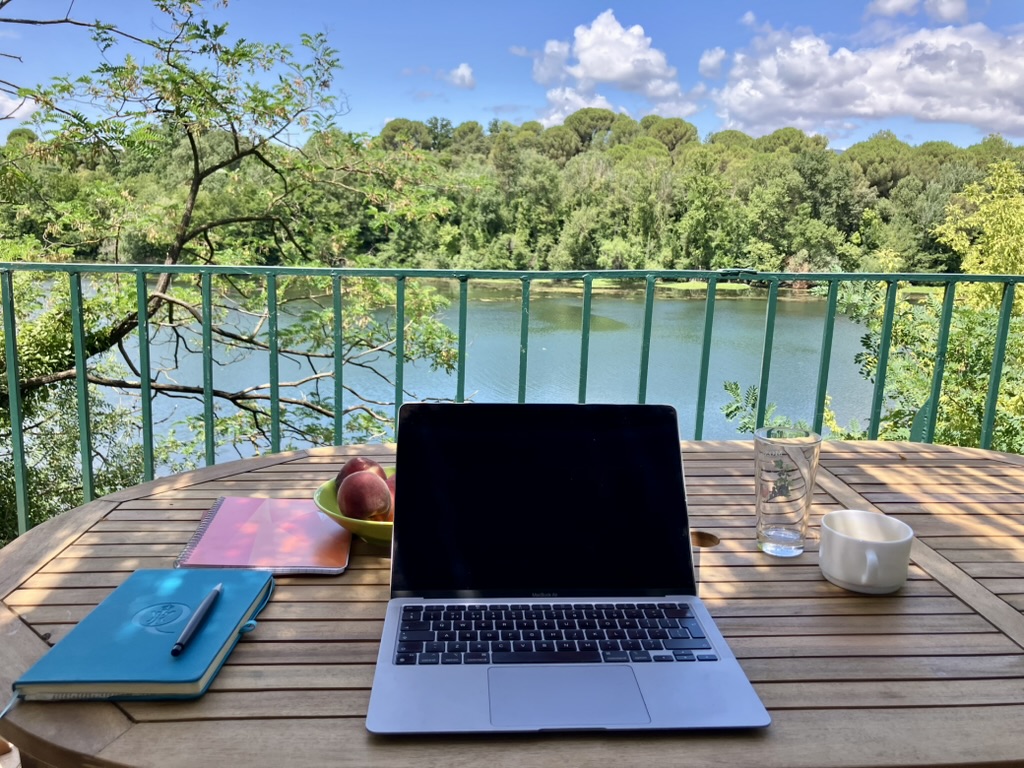
For the next five-plus weeks, this is my office. We got here at the end of last week after an exhausting ten days packing up the house for AirBnB guests, followed immediately by a two-week, 2,000-mile road trip, visiting family and friends en route. In Brittany late one afternoon the thermometer hit 45C in the shade. Here it’s a balmy 35C.
We’re in Occitanie, southern France, thirty minutes west of the lovely old university town of Montpellier. The département, Hérault, is named for the broad, slow river which passes twenty feet below me as I write, and which guarantees that however hot it gets, we will continue to be enveloped in lush greenery.
In the surrounding country there are vineyards and olive groves and an abundance of the fruit – peaches, nectarines, melons, plums, figs – that define the taste of summer in France. The light is strong and the horizon to the north and west is marked by hills, some low, some, distantly, a portent of the high limestone plateaux, steep forested slopes and deep gorges of the Cévennes that rise beyond.
The gîte is not much to see. In fact, it’s surrounded by so much crowding vegetation that you can’t see it at all. It stands at the foot of an unmetalled track, fifty yards from the farmhouse and the huge climate-controlled shed where our charming host, Jean-Francois, a peach grower, stores the fruit of his labours.
Perched above the river, the building occupies a site which has housed a mill since the Middle Ages. In the early 1900s, and the first flush of rural electrification, Jean Francois’ grandfather turned it into a small hydro-electric plant, powered by the river. It’s the remains of that industrial building that have been converted into our dwelling.
It’s simply furnished and has most of what we need – we buy whatever’s missing. There’s no air conditioning and we sleep with an electric fan going all night. But it’s very spacious and the terrace alone more than makes up for any shortcomings, as does the warmth and generosity of Jean-Francois and his family.
The terrace faces due west, so the sun doesn’t reach it till early afternoon. It’s a lovely spot to sit and write in the morning. The river flows slowly by, the occasional canoeists wave as they pass, and if I get up and lean over the balcony I can see large fish nosing about in the shallows. The knowledge that there is no human habitation on either bank for several hundred metres in each direction heightens the sense of peace and solitude.
Today there’s a strong wind blowing. It shakes the branches and loudly ruffles the leaves of the trees at either end of the terrace. But it’s not enough to silence the cicadas, whose courtship song has been going without cease since first light and will not end until sunset. It’s the inescapable soundtrack to my day’s writing.
In the evening the sun goes down directly across the river. There’s a pre-sunset hour of blinding reflection off the water and we have to rig up an umbrella, plus a towel or beach-wrap as a screen along the railings, until just before nine, when the sun sinks below the trees on the far bank and we lay the table for supper.
Then, as wisps of cloud turn peach and coral and the sky slowly darkens, small bats start to flit about, the cicadas fall silent and the frogs start up. At first a little squawk here, a croak there, then a small chorus of cackles, then the whole choir takes up the refrain and the opposite bank rings to what seems like a thousand batrachian voices. It’s a change of soundtrack in time for our evening game of Scrabble. They’re still at it when we go to bed.
(My last summer at school we staged Aristophanes’ The Frogs down by a small lake in the school grounds. I remember almost nothing about it except for the frogs’ chorus, of which I was a member. Our Greek chant went: brekekekex koax koax. Exactly so.)
Most evenings at the same time the dusk stillness of the river is broken by the V of a ragondin, a coypu, swimming to the far bank, where, we joke, he has a girlfriend. He’s usually back again within the hour. An invader from South America, he shouldn’t really be here at all.
You would think that with a wide, generally sluggish river, and an abundance of vegetation, there would be mosquitoes. In fact there are barely any. Obligingly, the frogs eat them. The small dusk-flitting bats polish off any that are left. Worse luck for the frogs, the herons eat them. There are a lot of herons.
There are also golden orioles which we seldom see, but which have a lovely liquid song, and then there’s the sky patrol: milans noirs, black kites, soaring and swooping over the river.
I’m becoming fond of them with their wedge-shaped tails and sharply angled wings, their rich, velvety brown plumage and soft cries. They seem gentle birds. I think they’re the guardians of this place. Sometimes they plane down to with a few feet of the terrace, just to check on us.
I reply that we’re all right. ‘Merci, Monsieur Milan, Madame Milan,’ I say. ‘Tout va très bien ici, au bureau.’
The title of this post is a rather oblique nod to the French TV series of the same name (also Le Bureau des Légendes). Set in the DGSE, the French foreign intelligence agency, it’s one of the best thriller series I’ve ever watched.







A beautifully lyrical piece, Jamie. The owner already emerges as the slightly villainous, comically threatening creature indispensable for any work which also proclaims a real joie de vivre. Bonnes vacances!
LikeLiked by 1 person
Merci bien, Joe!
LikeLike
Another deep, broad and high pleasure indeed…..to encounter and consume personal impacts and appreciation reflecting the beauteous characteristics of Occitanie, and of France, in so many respects. What strikes me most positively – and gives me great pleasure – is the repeating coincidental and subliminal reference to Scotland: entirely unintentional and by implication alone ( – in the hopes and expectation that Jamie would confirm as much!), and providing significant environmental and natural comparisons and instances of features in common between Scotland and France. Consider, as examples, these snippets of descriptive text within:
‘the light is strong and the horizon is marked by hills….low…steep forested slopes….deep gorges….’;
‘unmetalled track….’;
‘….sun doesn’t reach it ’til early afternoon….a lovely spot….’;
‘…….river flows slowly by…large fish nosing about in the shallows…..’;
‘…..no human habitation….heightens the sense of peace and solitude…..’;
‘….strong wind blowing…..shakes the branches….ruffles he leaves….’;
‘…evening the sun goes down directly across the river….until just before nine….’;
‘….the sky slowly darkens…..bats flit…..frogs start up….’;
‘…..evenings……dusk stillness of he river….’;
‘….generally sluggish river….and abundance of vegetation….’. Amazing – and a delight – to absorb the comparisons: virtually identities! They can but remind us in detail of the the forceful and lifelong links between Mary Queen of Scots with France, whither she was despatched as a five-year-old child, to flourish alongside the family of King Henri II and marrying Dauphin François II, to become Queen Consort of France……Little wonder, therefore, that Jamie’s superb tract, focusing, as it does, on Montpellier and on Hérault, revives and reinforces the permanent sense of romance which links France with Scotland!! – Thank you so much for a splendid commentary, in every respect.
LikeLiked by 1 person
Thank you. All true – perhaps? – but for the frogs! And a further link: in the 1920s, Patrick Geddes founded the College des Ecossais in Montpellier
LikeLike