
In the centre of our village of Birnam stands the Birnam Hotel, a large Victorian hotel. It was built in 1850 at a time when, following the queen’s example, tourists were starting to discover the majesty of the Highlands. When we moved here, roughly a hundred and fifty years later, it was still a viable concern, if somewhat shabby.
The rooms weren’t always full but it remained in regular demand for its most unusual feature: a first-floor baronial hall, complete with sprung dance floor and twenty-foot-plus high windows – the scene of wedding parties and other celebrations throughout the year, and at Hogmanay, the much-anticipated annual village ceilidh.
But it badly needed investment and none was forthcoming. Business dwindled and after a while it closed and stood empty. For a few years it squatted in the heart of the village with doors shut and windows lifeless, a dismal black hole sucking energy from its surroundings.
Then, eighteen months ago, it was bought by an enterprising young hotelier who runs the Taybank, a thriving pub in Dunkeld, across the river. Now it is undergoing a transformation.
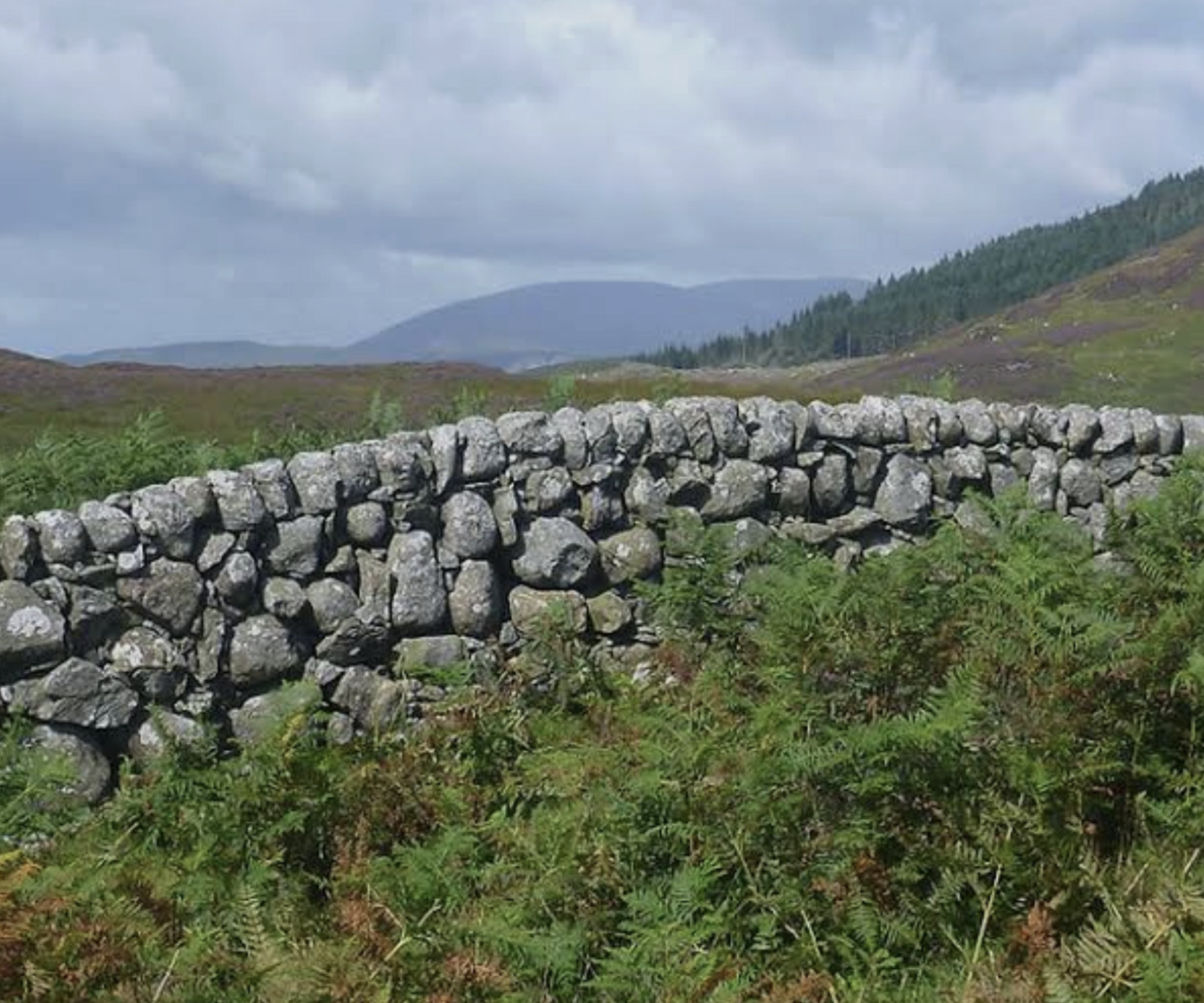
I pass it every day on my morning walk and long to see what the small team of local designers are doing inside. For now I have to content myself with what they post on Instagram. But I can see the very tangible progress of a drystone wall which has been rising, course by course, along the boundary between the hotel frontage and the road.
In the vernacular, this is a drystane dyke, which the Scots edition of Wikipedia describes as: a waw that is biggit frae stanes athoot ony lime tae bind thaim thegither. As wi ither dry stane structures, the dyke is hauden up bi the interlockin o the stanes.
I pause each time I pass and marvel at it. It is form and beauty wrested from chaos. Several tractor loads of field stones, of all shapes and sizes, lie in a huge, dense, dusty, heap to one side. From these the dykers select, one by one, the stone of the exact shape and size required to compliment its neighbour in the sequence of construction.
The wall has a course of large stones along the bottom, three courses of smaller ones in the middle, and large coping stones laid acrosswise, at the top. It tapers upwards from the base, and the centre is in-filled with smaller stones, pebbles and loose stuff.
Drystane dykes, often in some state of disrepair, were a prominent feature of my country childhood. I can picture them moss-covered, running along the edges of woods, stones spilt in places by falling trees; or marking the boundaries of grassy fields, bulging where cattle had pushed too hard or too often; or simply running up hillsides, straight dark lines against the bracken or heather.
I loved them because they were everywhere and they seemed almost to have grown out of the land; and because, even then, I had some appreciation of what it took to make them. But to watch a new one being built, as an existentially anxious septuagenarian at the dawning of the age of AI, is something else, a very special kind of grounding.
I love the slow, deliberate manner of its construction. The skill required to make it, the practised eye, the physical strength, the years of experience it takes. The aesthetic, the simplicity and evenness of line and form, that results. The sheer wonder of order and structural strength conjured from disorder and inertia. And the gravity of the material itself, matter that was formed millions, if not billions, of years ago and has since lain peacefully in the earth.
It takes me back to Orkney, to Skara Brae and Maes Howe, and that time when stone was all we had, along with the ingenuity and patience to shape it and heave it – the most obdurate stuff known to man. This hotel wall might not last five thousand years, but it will certainly outlast the drystane dykers who built it, and probably their children, grandchildren and great-grandchildren.
I realise that I am turning in what I’ve been writing lately to what comforts me. Nothing comforts me in quite the same way as a new drystane dyke.





 A Few Kind Words
They’re stunning and, like you, I marvel at the skill and experience required for their construction. I presume you are familiar with the artwork of Andy Goldsworthy? His book ‘Wall’ is a feast for the eyes…and brain.
LikeLiked by 2 people
I love Andy Goldsworthy, Emma. I’ll look out for Wall. Thank you!
LikeLike