Orkney is a gentle, green time machine. While the waters around it carry stories of sea-faring and exploration and the drama of two world wars, the land – low-lying pasture pocked with shallow scoops of water – tells a much older story.
Five thousand years ago it was a fertile haven for people who had crossed the seas in fragile craft. The region then was four degrees warmer, and the winds that scour the archipelago would have bitten a little less sharply.
These were people of the late stone age, the neolithic era. They had no metal, just stone and bone, wood and seashells from which to make their tools and fashion their artefacts.
And yet … they were able to quarry and dress giant slabs of sandstone weighing several tons, which they dragged into place to create sacred circles and the walls and roofs of burial chambers.
Some suggest they used rollers, but being almost treeless the islands would have lacked the necessary timber. Others suggest they hauled the stone on mats of slippery seaweed, as abundant as trees were absent.
These people, as many as twenty thousand of them, were fishermen and farmers who cultivated wheat and barley and kept animals including sheep and pigs and aurochs, the giant prehistoric cattle.
In this hospitable green place they lived and loved and left behind them a legacy of monumental structures that pre-date the Egyptian pyramids and Stonehenge.
In 1850 a great storm blew the sand from dunes on the western shore to reveal a settlement of ten well-preserved dwellings. This was Skara Brae which, once fully excavated, would prove to be the most complete neolithic village in north-west Europe; the houses clustered close together, today roofless, and all linked by short stone passages.
Rachel, the friendly and knowledgeable warden, who we would meet again the following day on ticket duty at the Stromness museum, points out the hearth in the centre of each house, the stone beds on either side and, facing the doorway, the stone dresser where household and precious objects were displayed.
Looking down into the Skara Bae houses from the raised walkway that weaves between them, it is easy to imagine the bustle of family life – the cooking and caring, the making and mending – that would have gone on in close neighbourly proximity to the other families of the village.
Perhaps, on given days, the villagers would have left behind their daily chores and walked the dozen miles to join people from other villages at the great circle of standing stones known as the Ring of Brodgar.
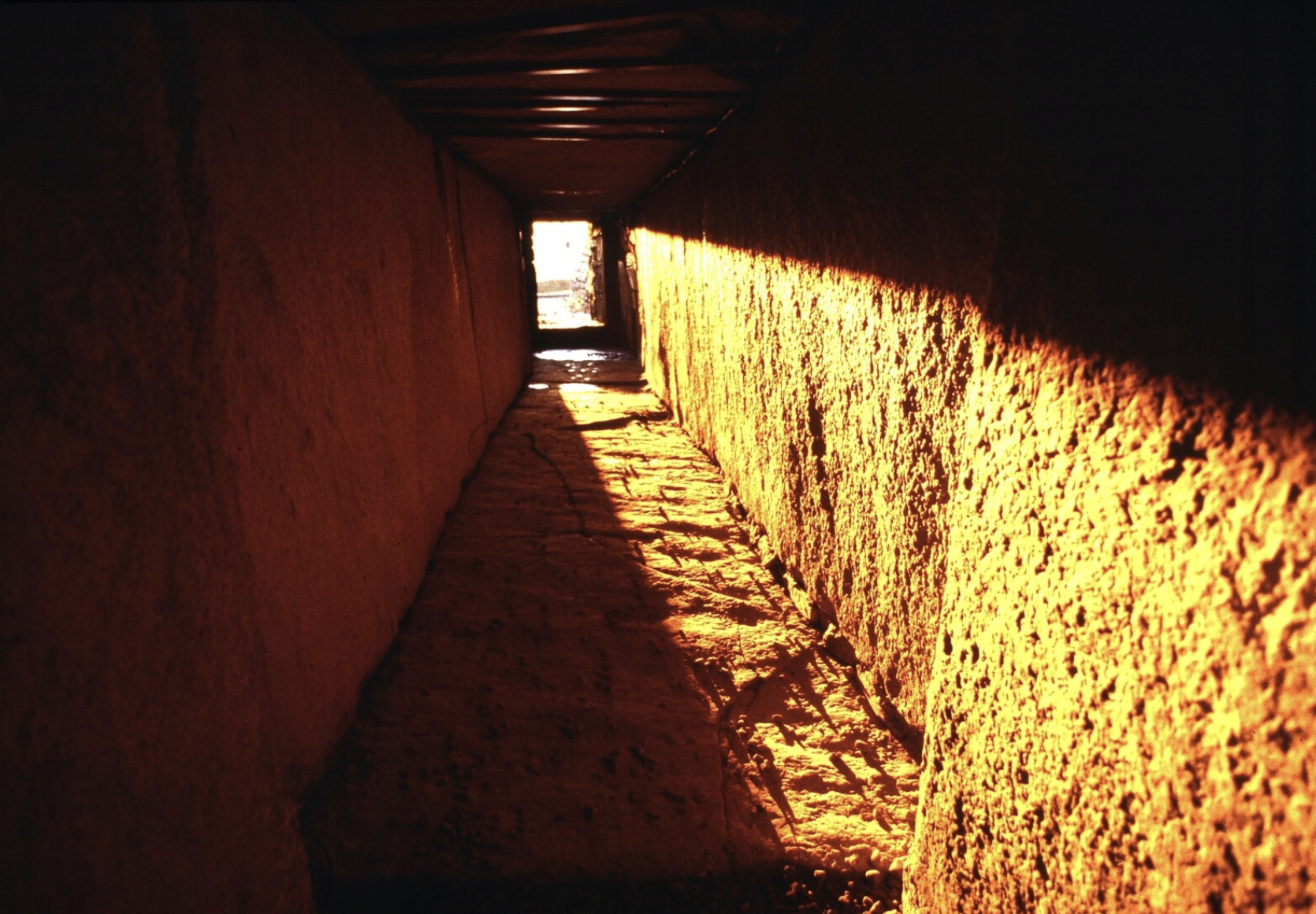
In mid-winter they might have walked a mile or two further to attend a ceremony at the burial chamber of Maes Howe; there to witness the light of the setting sun shine straight down the gently sloping passageway into the tomb and illuminate the back of the chamber.
Today the Ring of Brodgar has lost almost half of its original seventy standing stones. Those that remain ‘look like an assemblage of ancient Druids, mysteriously stern and invincibly silent and shaggy.’ So wrote the Scottish geologist Hugh Miller in 1846.
No one knows what happened within the circle, but at one hundred yards in diameter, one can imagine it filling with great gatherings of people for some ritual or ceremony. On a late spring afternoon, under overcast skies, Hugh Miller’s words ring loudly.
At Maes Howe, a thirty-foot passage burrows into the shapely green mound that conceals the chamber. The passage is only three feet high and we have to bend double to make our way along it. In the central space, slim, but nonethless massive, slabs of stone overlap like inverted steps to create what remains of the corbelled ceiling, twelve feet above the ground.
Today the empty chamber offers no clues as to its use, merely a patterning in some places of stick-like markings. This is the inconsequential, runic graffiti left by modern intruders from the twelfth century, the Viking equivalent of ‘Kilroy was here’.
But for all the banality of the graffiti, one can’t avoid the suspicion that in the elaborate construction and alignment of the chamber, these distant northern ancestors understood some mystery to which, tantalisingly, we are no longer privy.
As we leave Maes Howe a car passes at speed, heading down the long straight, empty road, one of many such which cross the island. It feels wrong somehow, jarring, a twenty-first century intrusion into a place that asks to be experienced at walking pace, slowly and reflectively.
Heading back to Kirkwall I am overwhelmed by the desire to travel back in time, even if only for an hour. I long to connect with our deep past, though I don’t really know why. Then it comes to me: it’s for reassurance, for the comfort of knowing that we can survive.