
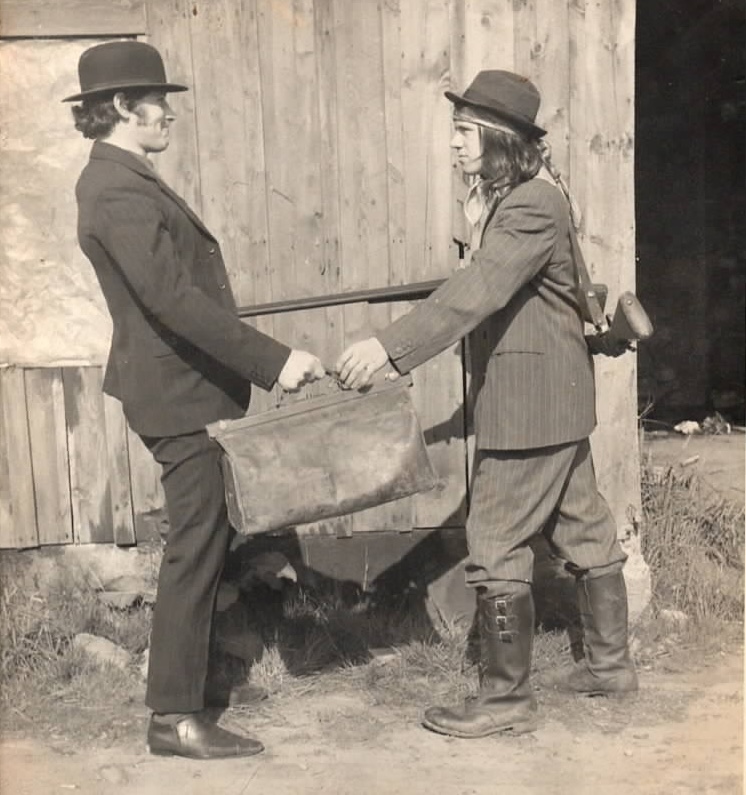
February is a month to be endured. As a student in a drafty rented farmhouse outside Aberdeen in 1970, we were visited one freezing February day by a particularly foul-tempered tradesman who had come to do work on the house. One of my housemates and I, somewhat under the influence, decided that the year could get no worse than this, and we would name the day after the tradesman. Thus 4 February became Webster’s Day, or Dies Websteriensis when we were being pretentious.
Dougie, the housemate, was a medical student. He had shoulder-length dark hair, wore a black leather jacket and played Leonard Cohen on repeat. When not tinkering with its dismembered parts, which lay in puddles of oil on his bedroom floor, he rode a motorbike. He was intelligent and witty, but a compulsion to fiddle with things mechanical, and a penchant for hash, relegated his medical studies to a poor third place. I didn’t then understand his pain.
Dougie’s father, Jim, was a senior civil servant in Edinburgh who enjoyed a parallel career as a respected novelist. He and his older brother, Douglas, as junior officers in the same regiment (most unusually), had been captured by the Japanese at the fall of Hong Kong and held as prisoners-of-war. When Douglas was suspected of organising a breakout he was interrogated, tortured, starved, made to dig his own grave, and executed with his younger brother looking on. He was twenty-five years old. He never betrayed his co-conspirators.
Douglas was a hero in every sense: handsome, clever, a good sportsman, captain of his school, and brave to the point of self-sacrifice. It was impossible for Dougie, his namesake, to live up to the name; equally impossible for him to step out from under the long shadow it cast. Periods of morose silence were not uncommon. In third year, after an altercation with the medical faculty, Dougie abandoned his studies and returned to Edinburgh where he took to joinery and house renovations.
I moved to London after graduating but we kept in touch. We were close friends by then. I had also introduced him to Carol, whom I’d known since childhood, and they had become partners. One weekend he was staying with me in London when we received a phone call late at night. Carol had killed herself in his flat. Next day I persuaded a GP I had never met before to prescribe valium so that I could get him on a plane back to Edinburgh. I flew with him and later we went to her funeral. He had never met her parents and didn’t think they would approve of him. He sat at the back of the church.
For a few dark years after that Dougie inhabited a netherworld of drugs and white vans and shady antique dealers. Then, in the late 1970s, he went to Australia and ended up living in Fremantle, on the west coast. There he built up a reputation as a cabinet-maker. He lived healthily, swam in the ocean every day, and seemed content with life. In the mid-1990s he came back to Scotland for a couple of years and met up with an old flame, Moira, with whom he returned to Australia. They settled happily together in Fremantle.
As Dougie’s parents grew older he started coming over every summer, sometimes with Moira, sometimes alone. He would always visit us for a couple of nights. He remained articulate, well-informed and entertaining, but as the years wore on we began to notice that he would struggle to find a word, or confuse one with another.
Then, at the time of the pandemic, Moira died. She had suffered for many years from lupus, but treatment in Australia had brought her a new lease of life, and the suddenness of her death took everyone by surprise. For Dougie, the shock was catastrophic, plunging him instantly into deep decline. Friends in Australia managed to get him on a plane to Scotland, and his sister in Edinburgh took him in. I visited him shortly after he’d arrived. He was convinced that his sister and elderly mother, who lived with her, were actors playing roles in an international conspiracy of which he was a victim.
Four years on and he is in a care home in Edinburgh. I would like to be able to say that I visit him regularly. I don’t. The last time I saw him, more than a year ago, there was a flicker of recognition as I sat and held his hand and chattered inconsequentially. Then he slumped forward into his reverie again.
I haven’t forgotten Dougie. I never will. And writing this today, I know that I must visit him again, soon. Meanwhile, I’m glad of Webster’s Day as an annual reminder of a clever, funny, talented and sometimes infuriating friend for whom the burden of the past was simply too heavy, the shadow too long.
Pictured: fooling around on the farm circa 1970, Dougie at right.





 A Few Kind Words
My gosh, Jamie. This is very moving – thank you for sharing. Here’s to Dougie x ________________________________
LikeLiked by 1 person
A poignant piece that honours a dear friend and I’m grateful for your sharing it.
It is also a reminder that it is just as well that we do not know the future as the past already has more than enough power to blight us.
LikeLiked by 1 person