
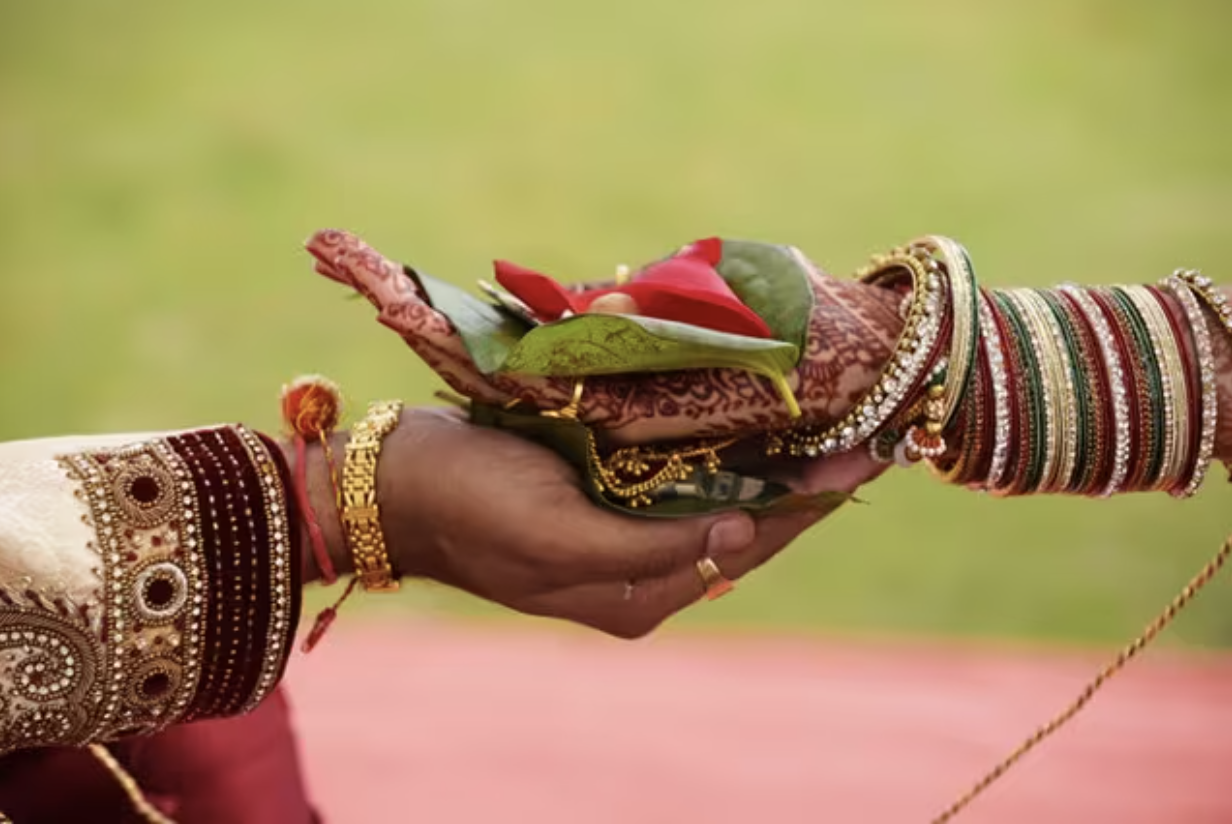
It all began last night with a large party in a central Delhi hotel. There were several hundred guests, a famous band and dancing. This was Sangeet, the first of a number of events to celebrate the wedding of my friend Pramod’s only child.
Today the family have gone back into town for Mehndi, the henna-ing ceremony. Here at the family home, a large property on the southern outskirts of the city, the grounds are swarming with workmen, creating stages and seating areas for tomorrow’s Vivah, the marriage ceremony.
I’ve known Sonali since she was a little girl. One summer, when she was six or seven years old, she came with her mother to visit us in Scotland and spent a week at the local primary school; a small brown Indian girl among half-a-dozen large pale Scottish children, in a tiny school in a Highland glen.
I have a photograph of her wearing a tartan skirt with our two children in the garden. Today she’s a senior strategist with a climate consultancy in Mumbai. Last night, dancing with Rohan, her husband-to-be, she was radiant and beautiful.
Pramod, her father, I met when I first went to London after graduating, in 1971. We were trainee recruits to a firm of accountants. In his case, with a degree in commerce from Delhi University, this was entirely appropriate. In mine, the law degree from Aberdeen University notwithstanding, it was wildly inappropriate.
I wanted to write stories and be a singer-songwriter. But my father and stepfather, a lawyer and banker, conspired together, made a couple of phone calls, and there I was with a job I didn’t know I wanted. That was the way things worked in those days. While Pramod not only stayed the training programme, but went on to enjoy a spectacular business career, I quit after six months.
It was an act of rebellion, my first adult reaction to a largely very conventional upbringing; the ‘largely’ an acknowledgment of the fact that my mother, though conservative in many ways, encouraged us (my father would have said incited – they were separated by then) to push the boundaries when it came to such things as travel and the arts.
My brief and disagreeable brush with accountancy behind me, I worked for a spell in a central London bookshop, then took off for South America. Pramod and I by then had become close friends.
In London I’d met his student cricketing friends from Delhi, we’d stayed up late talking about eastern philosophy and religion, and he’d taken me to a huge Indian restaurant on Regent Street where he showed me how to eat with my fingers. In return I’d invited him to Scotland over Christmas. We took him on a pheasant shoot where he perished with cold, but was too polite to say so.
For all his western appearance, there was something fundamentally different about him that intrigued me. Also, he was mischievous and fun to be with, and there was between us that simple chemistry that cements the foundations of all enduring friendships.
By the time I got back from my travels Pramod had qualified and was about to leave on his first professional assignment, a two-year spell in his company’s offices in Bahrain. We spoke in the days immediately before he left, it may even have been at the airport, and I remember that he seemed uncharacteristically anxious about this next step in his career.
He needn’t have worried. Within thirty years he would be acknowledged as the father of a whole new Indian industry, business process management. Today he is an elder statesman, one of India’s foremost business figures, chairman of economic think-tanks, founder of educational institutions and so on.
Back then, we lost contact. I got a job on a magazine and bought my first flat. It was a ground-floor-and-basement in Notting Hill. The building, a hundred yards or so from Portobello Road, rejoiced in the name of Mole Mansions. Life went on and, lacking each other’s phone numbers or addresses, Pramod’s and my friendship receded into the background.
One day I had just left the flat and was heading down the street when I saw coming towards me the unmistakable figure of Pramod. He was back from the Gulf. He had an American girlfriend. And he was living with her in the same street, five doors down from me.
It’s tempting to look for meaning in these moments, or to ask what might otherwise have happened. I try to resist that urge. Today, half a century later, it seems enough to know that we remain close friends, and that there could be no better way of celebrating the fact than to be here in Delhi for Sonali’s wedding.






 A Few Kind Words