
On Saturday, I am taking one of my most treasured possessions to hospital. It’s a two-thirds size guitar which I bought while travelling in Latin America in 1973. It is now so cracked and battered that I daren’t play it any more. This weekend it’s going in for treatment.
When I bought it I was three months into a ten-month-long journey through South, Central and eventually North America; an experience which remains with me vividly more than half a century after the event, and about which I’ve often written here before.
At the time I had a beautiful guitar at home, but I hadn’t wanted to risk taking it on the road. My girlfriend and travelling companion had given me a nice travelling guitar, but it had been stolen in Bolivia.
A couple of weeks after that, a hair-raising road journey from Cuzco, out of the Andes and down into Amazonia, in the rains, had brought us to Pucallpa, a muddy frontier-town of a few thousand inhabitants, on the banks of the Ucayali River. There we were going to catch a boat for the 600-mile journey downstream to the confluence of the Ucayali with the Amazon, at the Peruvian port of Iquitos.
Thrown around in the back of a truck for several days as we negotiated precipitous roads, biblical downpours, mudslides and bogged vehicles, I’d had little time to think of music. But now that we had a day to kill I set out, with almost no expectation of success, in search of a guitar.
I remember a rectangular grid of streets deep in mud with raised wooden sidewalks, clapboard buildings, men on horseback, rattletrap vehicles, waterfront warehouses piled high with exotic animal skins, and then, miraculously, a shack where a middle-aged man and his teenage son were bent over a workbench, the wall behind them hung with guitars.
The father showed me a couple of beautiful instruments made from some kind of tropical wood, dark and gleaming. But they were too expensive. Then, almost bashfully, the son showed me one of his. Although it was made of something nearly as light as balsa-wood, it had an easy action and a deep resonant tone. I paid ten dollars for it.
My journal tells me that it was 14 March 1973. The crudely handwritten label inside the guitar tells me it had been made only a few weeks earlier, on 17 February, by Damián Estrella Co. I’m guessing Damián Estrella was the father. The son was fourteen years old.
For the next six months I carried it with me in a yellow plastic fertiliser sack. Long waits at bus stations, and occasionally at the roadside, were a regular feature of the trip. There the little guitar came into its own. I wrote a lot of songs during that year, several of which I went on to record.
Since then it has travelled with me and done faithful service wherever I’ve lived. My daughter has played it. Last summer it came with me to France for two months. Given the age of its maker, I marvel at its character and tone. Given what it’s made of, I marvel at its survival. And I cherish it, above all, because it’s the one tangible object remaining to me from that epic year of travel.
Somewhere in the Amazon rainforest someone had felled a tree, from which a cut or two had come into the hands of a teenage boy in ragged shorts, with rubber-tyre sandals on his feet, who was learning his craft from his father, in a shack in a muddy street in an out-of-the-way jungle town in Peru. The spirits of that tree, that place, that boy, live on in my little guitar.
Beneath the signature, the young maker had added the word ‘Atahualpa’. The name of the last Inca emperor, it was also I guessed, though my journal doesn’t mention it, the name of the street where the guitar shop stood. Pucallpa today, I learn, is a thriving city of half a million people. Jirón Atahuallpa is a street running from the centre to the waterfront. Is it the same one? Very likely.
There are guitar shops in Pucallpa today, too, several of them. But now they boast sleek electric instruments and amplifiers, and there are none on Jirón Atahuallpa. Of Damián Estrella I have been able to find no trace.
How I would love to be able to tell the young maker, now a man in his mid-sixties, about his little guitar, about how it ended up in Scotland, and about all the adventures it has had along the way.





 A Few Kind Words
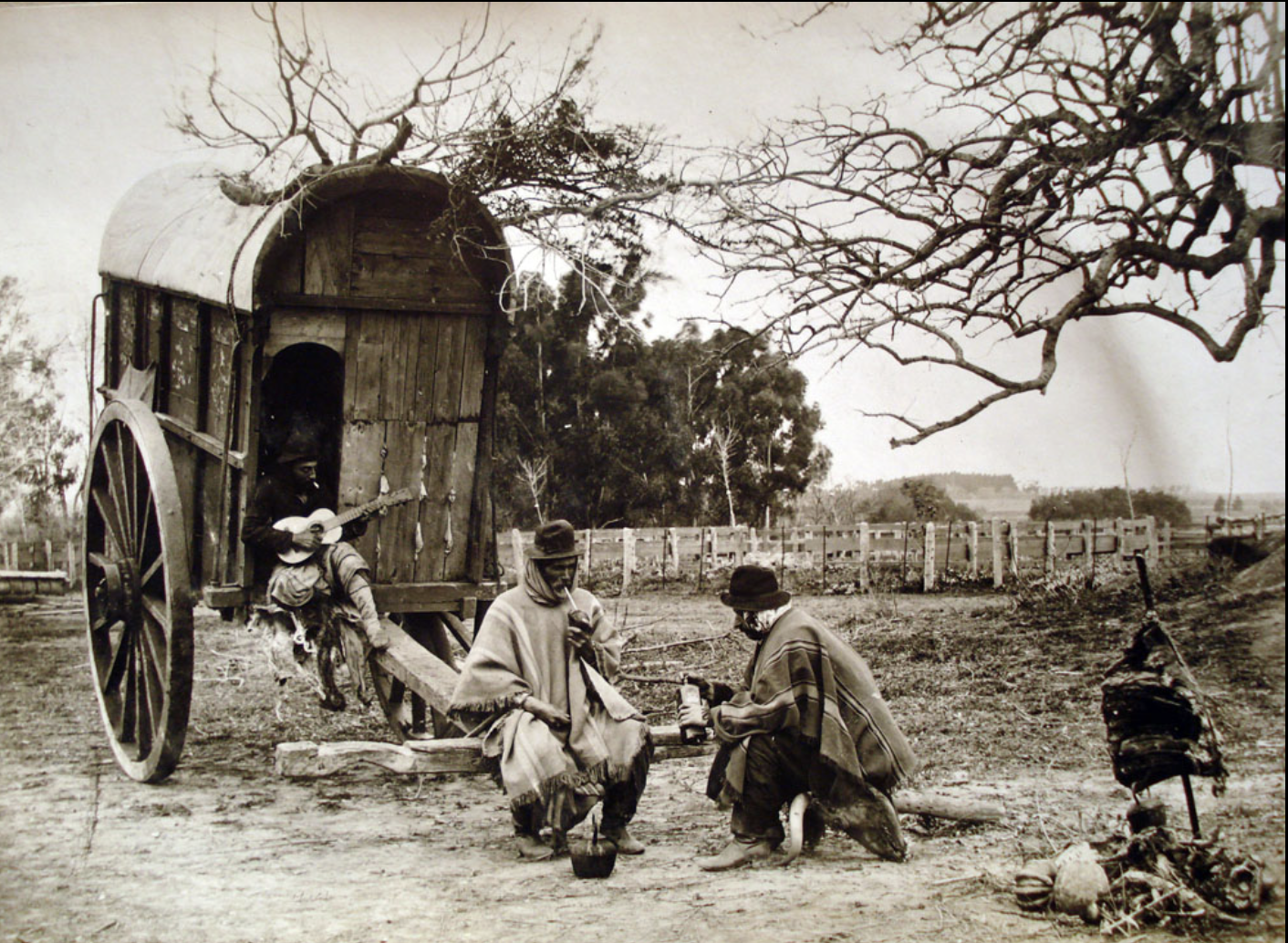
Beautiful story, Jamie, and the little guitar at the heart of it. I hope it gets the treatment it needs in hospital. A fine photograph to accompany the story too. Do you know when or where that is taken?
LikeLiked by 1 person
Yes, it’s an archive photo of gauchos from the late 19th century which I found online and use in my Don Roberto talk (Argentine admittedly, not Peruvian!).
LikeLiked by 1 person
My conscience and instincts combine to advise me not to overdo comments for many and varied good reasons! – so I hope that a few relevant and realistic thoughts won’t go irretrievably nor yet unforgivably amiss?! – My pleasure and admiration in respect of the guitar-led narrative and commentary don’t – regrettably and unfortunately – reflect musical sympathy and empathy on my part, as I’m not a musically gifted nor even educated or skilled individual – much as I enjoy musical output, not least / especially guitar-led instances and eras, such as the ’60s and ’70s ‘Jazz’ years, which I enjoyed immensely then and recall with pleasure e’en now! What impresses me endlessly in respect of The Little Guitar Big Saga is – admittedly far less relevantly so, notably in the perception of many musical admirers of the life of that guitar! – the remarkable and very pleasing coincidence due to the fact that, as an International Investment Banker in my ‘second profession’ – I specialised in Emerging Markets Equities, especially so in Latin America. I travelled throughout L.A. repeatedly for many years, in wild, savage and underpopulated areas as well as in the familiar and prominent capital cities and industrially / agriculturally active areas. (I also spent occasional intervening weekends there, and twice travelled solo – but not far! – up and along the Amazon!) The perception and the skill of remembering and recounting local and locational details (co-)incidental to the travel-routines in which the Little Guitar participated are remarkably acute and evocative – the more so as conjuring up surroundings as they were between 50 and 60 years ago! The intermediate references to ‘wooden sidewalks’, ‘rattletrap vehicles’, exotic animal skins’ and balsa-wood guitar-formation, although serving ‘en passant’ relative to focus on the Little Guitar itself, are reminiscent of a remarkable awareness and memory relating to South America as it then was, e’en in microscopic detail….and largely no longer is, due to time passing! What a wonderful reminiscence and memory in every respect this Little Guitar Saga carries with it…..thank you very much!
LikeLiked by 1 person
sounds like a trip to that place is in order- investigative searching for that man!!’
LikeLiked by 1 person
I suspect the young lad, now in his mid-sixties, would be amazed that his guitar is still in one piece and so-cherished as to be worth repairing.
I also love how the guitar evokes such memories and the flair with which you recount them.
I agree with Carolyn that a trip back to Pucallpa in search of el Señorito Estrella would be amazing, especially were you lucky enough to find him.
LikeLiked by 1 person