
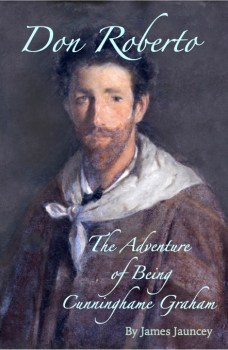
Two years ago I published a biography of my great-great uncle. He and I were born almost a century apart: he in 1852, I in 1949. We also arrived in South America almost a century apart, in 1870 and 1972 respectively, at similar ages. He was eighteen, I was twenty-three. But whereas he had gone there to become a cattle rancher and restore the family fortune (he succeeded in neither), I was merely a hippy traveller, a late developer in search of myself (I also failed).
He went on to spend six out of the following eight years there, while I spent little more than six months, and most of our experiences of that extraordinary continent were wildly different. But I believe South America had one crucially similar effect on both of us. It turned us into writers.
In his case it would be a further twenty years before he began to recount his South American experiences; he had a brief but explosive political career to pursue first. When he did eventually settle down to write, in his late forties, he developed his own particular literary form. The sketch was neither fiction nor memoir, but a way of telling stories of incidents and encounters from his own lived experience, related by an often anonymous narrator.
As a child, he had been encouraged in the habit of observation by his mother. Although he had no idea he was storing away this treasure trove of material at the time he was in South America, nor later ever truly believed in his literary gift, his sketches today read like little jewels of description and wry comment on human foible. Frank Harris, the influential publisher of the Saturday Review, said of him in the early years of the 20th century: ‘In his stories are the painter’s eye and a superb painter’s talent. One or two of his sketches of Paris life de Maupassant would gladly have signed …’
I have been re-reading many of them lately, because I’m working with a couple of colleagues to pull together an anthology of his writings, an introduction for those who are new to him. One, which is probably not destined for inclusion, stays in my mind. Titled Writ in Sand, it appeared in his penultimate collection, of the same title, published two years before his death in 1936.
It describes the arrival of a circus somewhere in France, the setting up of the tent, the performances – Chinese jugglers, a troupe of North African acrobats, a clown dressed as a matador – and then the immediate dismantling of it all following the show. He writes:
‘By daybreak all was ready for the road. Nothing remained on the bare space of ground, upon the outskirts of the town, of all that microcosm of human life, its dangers, beauties, disillusions, loves, hatreds and jealousies. Nothing was left to mark the passage of the great town of canvas that had arisen in a night, fallen in an hour, and passed away, like life – nothing except a ring upon the sand.’

For me it was the habit of journal-keeping during my time in South America that proved fruitful. At times, in fact, it felt like the only way I could justify to myself the indulgence of meandering through Latin America when many of my contemporaries had already settled down to adult life and serious jobs. But while I may still not have known who I was or what I was going to do when I finally came home – and the landing was very bumpy indeed – on some level I knew that it had to involve writing. (And so it did. Within a year I had a job as a staff writer on – of all possible ironies – a careers magazine.)
During that year of travel – which began in Buenos Aires and ended in Toronto – I wasn’t only writing a journal. I was also writing songs. My girlfriend and travelling companion had given me a guitar before we left. It was stolen when we were in the Peruvian Andes. A few weeks later I found a replacement, in the jungle town of Pucallpa on the fringe of Amazonia, a ramshackle frontier settlement where I would have put the chances of buying a guitar at less than zero. But fate was smiling. In a shack down a muddy lane was, yes, a maker of beautiful guitars.
I couldn’t afford his, but his fourteen-year-old son had made a two-thirds-size guitar which I bought for ten dollars. It weighed next to nothing, being made of something almost as light as balsa wood. I carried it with me for the rest of the journey in a yellow plastic fertiliser sack, and I have it still today, cracked and battered but still resonant, still playable. Its adolescent maker, whose name was written on a label inside it, would now be in his mid-sixties. I’ve tried unsuccessfully to find him on the internet.
I went on to record a number of those songs, and to play them in a trio which haunted the graveyard shift on BBC Radio Two in the late 1970s and early 1980s. One of them drew for inspiration both on the scenes of simple travelling shows we had witnessed in out-of-the-way places in South America, and also, for its concluding lines, on the later sight of an empty and desolate Shepherd’s Bush Green, the day after a circus had moved on.
Titled The Carnival (Don’t Come Here Any More), its final verse and chorus ran:
The jugglers made us laugh at their display
The acrobats, they took our breath away
But best of all we loved the puzzled frown
The funny walk, the antics of the clown
Now the carnival don’t come here any more
Don’t hear that music at my door
Just paper blowing round
A patch of empty ground
For the carnival don’t come here any more
Is it coincidence that we had both been struck by the same images, the same thoughts, nearly a century apart? Of course, the circus itself is a universal metaphor for life, as he points out; and there’s something equally universal about the despondency of ‘the day after’ – the thought that one has experienced something rare and magical and larger-than-life, only for it to vanish into the mist. Acrobats, jugglers, clowns, these are circus staples. But ‘the bare space of ground’ and ‘a patch of empty ground’?
We all look for connections, as writers perhaps more than most. I like to think there’s one here; one of several that have helped make sense of my choice to become involved with his life and legacy.





 A Few Kind Words
Unique, despite serial-appearance over very many years – multidimensional – fact blending cogently with sentiment and personal observations – as rare and rarified an artistic and creative product as one could ever be fortunate enough to encounter…..
LikeLiked by 1 person
Another beautiful piece, Jamie. I have so many happy memories of hearing you play this song in different place around the world. The thread continues …
LikeLiked by 1 person
This connection is why I thought your working title for the biography “Don Roberto and Me” was so perfect a description of the various tangents of your lives a century apart.
LikeLiked by 1 person