
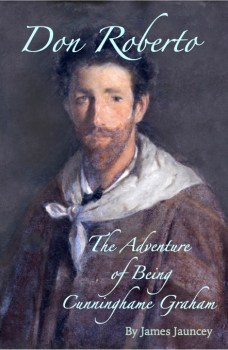
Last Friday we launched Don Roberto: the Adventure of Being Cunninghame Graham at the Scottish Storytelling Centre in Edinburgh – a fitting venue since its director, Donald Smith, first encouraged me to give the talk which later became the book. That was nearly seven years ago, seven years in which the almost mythical figure of my childhood has gradually become something more of a human being.
It was a cheerful gathering of people who mostly had either a literary or political interest in him. I gave a short talk and took some questions. One was: what have you learnt about yourself in the writing of the book? In a moment of panic I thought: I don’t know … and maybe I haven’t learnt anything … and if so what a waste of an enormous effort. Then I answered: that I’m probably a coward. It felt glib, but also apt because one of the things I came to admire most about my great-great-uncle was his courage, and one of the things I noticed as I wrote was that I was constantly asking myself whether I measured up to him.
Robert was physically courageous. His six years in South America taught him to be so. To ride with and be accepted by gauchos was to brave the terrors of hostile Indians, bandits, feral cattle, jaguars, poisonous snakes, and the very real prospect of being thrown from his horse in terrain where injury might lead to abandonment and death.
I have been very frightened twice in my life, once on my gap year in Kenya when I was in close proximity to an elephant as it was shot (I’ve written about it here before) and once on a skiing holiday when I lost my way at the end of the day and thought I was going to have to spend the night on the mountain. I know that nothing would induce me to repeat those experiences or put myself in a position where I might be exposed to anything similar. Yet Robert chose to live with physical danger, not only during those six South American years, but on a number of other occasions during his long and eventful life.
More than physical courage, though, I came to admire his moral courage. From his maiden speech in the House of Commons in 1887, until his final public appearances in the 1930s in support of the nascent Scottish independence movement, he voiced opinions that were as unpopular as they were unfashionable.
The royal family were parasites, he declared, liberal party grandees, the new class of industrialists, were exploiters and extortionists, the House of Lords was fit only to be abolished, women should have the vote, the working day should be limited to eight hours, animals should have rights, the Imperial project was corrupt and debased, the treatment of indigenous peoples by their European colonisers inhumane and disgraceful, and so on. Robert was driven by a fierce sense of injustice, and he cared not the least what other people thought of his views, nor how much trouble they landed him in.
I care probably too much what people think of me, which can be a great inhibitor when it comes to saying what I really think and believe. I have stuck my neck out on occasions, and I will speak up for the things I deeply believe in, but I am not a fearless campaigner in the way that he was, and sometimes I think, with envy, that I should be. Cowardice may be a strong word for what I’m describing, but it’s the word that came out in the moment, and if Robert’s character is the benchmark, then there’s at least a grain of truth in it.
To write a book of any kind is inevitably to hold a mirror up to oneself. A biography of a relative is a highly polished one, and if some of what one sees in it leaves one feeling lacking, I guess that’s part of the process.
Don Roberto: the Adventure of Being Cunninghame Graham is available from Scotland Street Press at £24.99. Order here.





 A Few Kind Words
It does us all good to look in the mirror now and again but coward isn’t a word that I’d associate with you! Different times, different bravery! Just as many snakes and bandits in board rooms when you’re leading the way to tackle business speak.
LikeLike
Thanks Gillian – and yes, it’s a long time since I faced the boardroom challenge, but you’re right!
LikeLike
I think you’re being a wee bit hard on yourself, Jamie. At one level, cowardice is simply the instinct for survival kicking in. And it may not always be physical survival, but perhaps survival in a role or emotional survival that seems paramount. Similarly, courage is sometimes a thinly disguised form of self-confidence or, less admirably, arrogance.
Where courage really kicks in is when one has to limit the survival instinct in order to get something done. Think of all those Ukrainian men and women who have had to become fighters, likely to be seriously injured, traumatised or killed in defence of their country.
There’s a wonderful poem by Sorley MacLean called ‘Curaidhean’ (‘Heroes’) which explores some of this in the context of the desert war in which MacLean himself fought and was wounded. He recounts the death of a comrade, no hero at all, yet a man of courage – ‘a great warrior of England / a poor manikin on whom no eye would rest; / no Alasdair of Glen Garry; / and he took a little weeping to my eyes.’
Sorry we missed the launch, but glad you got a good gathering of cheerful friends.
LikeLike
Thanks James – yes, the Ukrainian parallel is a very telling one, and Robert could indeed be arrogant at times, probably as a defence. What a beautiful excerpt from ‘Curaidhean’. The launch was great and people are saying nice things about the book so far!
LikeLike
Another great bit of writing.
My reaction to the question would have been identical – I don’t think I’m very good at introspection and am probably quite a shallow person in that respect. I also would have to admit to cowardice, and when trying to be courageous, tend to exhibit foolhardiness rather than bravery. I think most people want to be liked and worry too much about what others think of them – I know I do. But then, if Don Roberto is our hero and our standard, it is a very high bar he has set.
You know there is a chair in the Storytelling Centre dedicated to Don Roberto, on which one of your audience may well have been sitting.
LikeLike
Thanks Robin. It was a standing event, but I’ve seen the chair in the past. It says something about him being a master storyteller.
LikeLike
I think heading out into the Sahara with me is pretty courageous 🙂 Also, there’s a big difference between worrying about what other people think and caring about the impact you have in the world. Compassion takes courage; you have plenty of both.
LikeLike
I agree on the first point Neil! And I think (hope) that our route will take us through the mountain pass where he was captured. by the Caid of Kintafi – possibly a lesson there in recklessness rather than courage on his part!
LikeLike
I’m sure we could make it so. We could even stop to stage a re-enactment 🙂
LikeLike