
The grey shingle of Whidbey Island’s beaches is littered with driftwood, testament to the arboreal abundance of the Pacific Northwest. Whole trees, branches, fist-sized lumps lie along the tideline like the bleached bones of sea monsters.
Under dull, rain-laden skies I watched a heron stalking through the shallows to spear a fish, only to be relieved of its still-flapping catch a moment or two later by a bald eagle which swooped down with an imperious screech. The heron moved off in disgust. The eagle stood over its booty, looking around with a nonchalant air. Take me if you can, it seemed to be saying.
We were visiting a distinguished local artist, Claudia Pettis, whose extraordinary life-sized oils and charcoals of sheep could only have been made by someone with intimate knowledge of her subject. This Claudia has, having shepherded her own flock for many years. She brings gravity to her work, an understanding of technique which reaches back to Rembrandt and Titian, along with a profound and searing commitment to her life and practice as an artist.
With her husband Chuck, a brand consultant and creator of sacred sites, she lives in an airy modern steel-and-stucco home on a bluff overlooking Mutiny Bay – named in 1855, says Wikipedia, by the United States Coastal Survey which disappointingly failed to offer any explanation for the choice of name. Further investigation suggests that it may relate to a number of British sailors who deserted their ship and stayed to become settlers. Or to the Indian crew of a trading vessel who conspired with local Indians to kill the white owner and mate and steal the cargo, consisting largely of whiskey. Or … it was ever thus with place names.
Whidbey Island is about fifty miles long and lies in Puget Sound, a short distance northwest of Seattle. It is sheltered from the Pacific by Vancouver Island to the north and the headland on which rises Mount Olympus and its national park, to the south. A 20-minute ferry crossing from the mainland terminal at Mukilteo takes you to the southern end of the island.
Here, at least, the island is distinguished by the absence of either golf courses or marinas, which is one reason that its little townships are sleepy, and that it draws seekers of solitude such as Claudia and Chuck, my friends Richard Pelletier and Linda Massey, and the creators of the Aldermarsh Retreat Centre where we spent much of the last week.
The whole island is densely covered by trees, most of which dwarf our native British species. Even the telegraph poles are three times the height of ours. Clearings, when one comes upon them, are little oases of pasture and timber-clad houses where the flood of light seems precious. Such was the feeling at Aldermarsh, with woodland crowding up to the main buildings and setting a dense green boundary to the gardens.
From these buildings a forest path led to a wooden walkway across the short corridor of marsh above which slender trees – alders perhaps – bent their heads together in conversation. Beyond was a large expanse of cut grass with a circle of small stones at one end, dubbed ‘Pebblehenge’ by one of our group, and a large octagonal – or was it hexagonal? – meditation room, where we convened to write, seek inspiration and discuss ideas.
Whidbey Island has a slow but insistent creative energy. Whether this is the cause or the consequence of the presence of its many creative residents – bee-keepers and bakers, wood-carvers and winemakers, potters and poets, writers and photographers – I wouldn’t like to say. But with shared thoughts and words, good companionship, and unexpectedly extravagant catering, Aldermarsh offered us a welcome retreat – five days of escape from our daily lives and, for me at any rate, an abiding memory of grey skies, tall trees and minds enlivened.
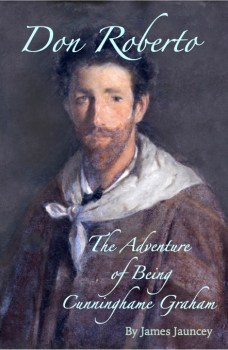
I am speaking about Don Roberto: the Adventure of Being Cunninghame Graham at the Edinburgh International Book Festival on 20 August. Book here.





 A Few Kind Words
I’m very glad to be on your mailing list for A Few Kind Words. I always enjoy reading them. Thank you.
LikeLike
Lovely.
LikeLike